
GearAndSteel is reader-supported. As an Amazon Associate I earn from qualifying purchases. When you buy through links on our site, we may earn an affiliate commission, at no extra cost to you. Learn more.
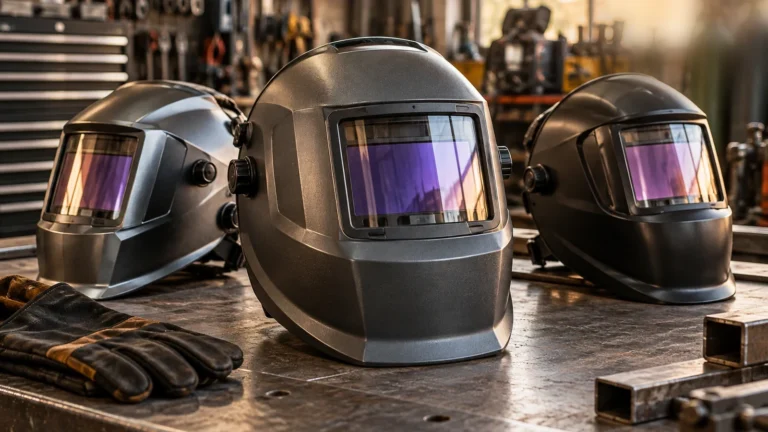
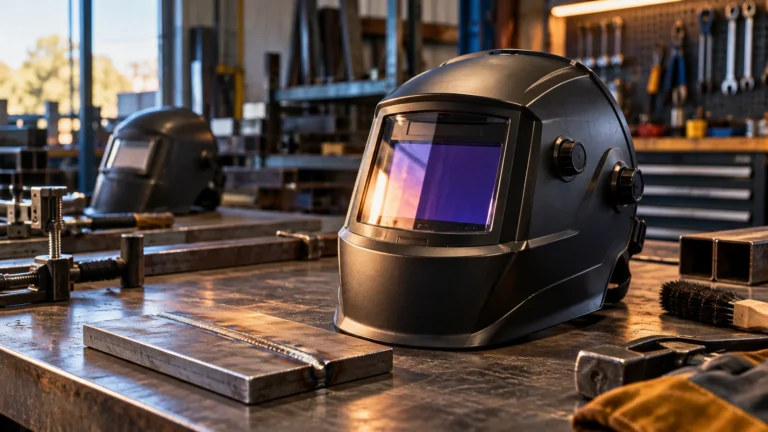
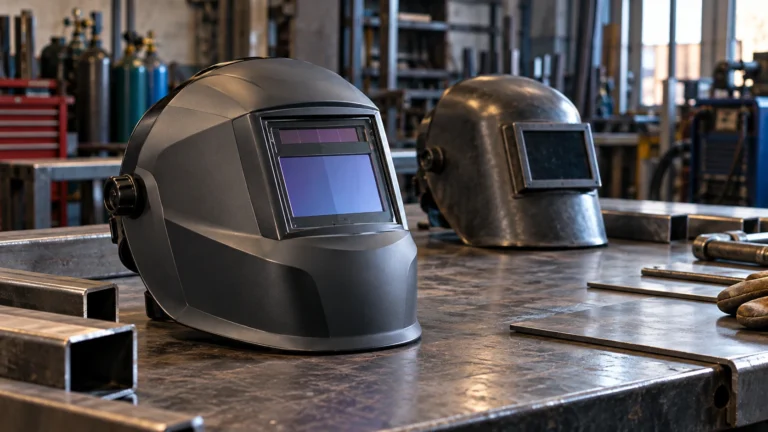
An auto-darkening welding helmet is a good choice when you want to position the torch or electrode with the hood down and see the joint between arc starts. For MIG and stick work, prioritize a correctly rated filter, a usable shade range, secure headgear, and replacement lenses. If you also weld low-amperage TIG or work around obstructions, sensor performance and filter sensitivity deserve more attention than a large viewing window alone.
Start with the welding you actually do
The main buying mistake is treating every variable-shade helmet as equally suitable for every process. A filter that works reliably with an unobstructed MIG arc may have more trouble detecting a low-current TIG arc behind a pipe or fixture. Four sensors can help, but their number is not proof that a blocked or weak arc will always be detected. Follow the helmet manufacturer’s supported applications and low-amperage specifications.
| Your work | Start by checking | What could rule it out |
|---|---|---|
| Occasional MIG or flux-core on a clear bench | Appropriate shade range, marked protection, replaceable cover plates, stable headgear | Poor fit, unclear protection documentation, difficult-to-source covers |
| Frequent low-amperage TIG | Manufacturer’s stated low-amp TIG performance, sensitivity range, sensor visibility, optical clarity | No published low-amp support or inconsistent triggering during the prescribed pre-use checks |
| Fabrication with frequent tack welds | Adjustable delay, comfortable balance, easy controls with gloves | A headband that slips or controls you cannot operate reliably |
| Welding followed by grinding | Clearly indicated weld/grind mode, fit with required safety glasses and other PPE | A grind switch that can be left on unnoticed before striking an arc |
If you’re still deciding between a passive helmet and an auto-darkening model, that is a broader helmet-selection question. Here the assumption is that you want an auto-darkening filter and need to choose one that suits your welding rather than a generic popularity ranking.
Six specifications that change the decision
1. Verified eye protection and the right welding shade
Look for identifiable manufacturer markings and documented compliance with an applicable ANSI Z87.1 eye and face protection standard. The helmet, its filter and its cover plates have different jobs. A statement such as “true color” is not a substitute for protective markings or a manufacturer’s instructions. Replace damaged or improperly fitting components with parts approved for that exact helmet.
Shade settings depend on process and arc current, not the label “MIG” or “TIG” alone. For example, OSHA’s 29 CFR 1910.133 filter table lists a minimum shade 10 for gas metal arc welding at 60 to 160 amps, while its gas tungsten arc welding entry at 50 to 150 amps lists a minimum shade 8. These are minimums, not universal comfort recommendations. Start darker and adjust only to a shade that lets you see the work without dropping below the applicable minimum; follow your specific equipment and workplace requirements. A full process-by-current shade chart belongs in a separate reference, not on this product-selection page.
2. Arc sensors, sensitivity, and the low-amp question
Arc sensors need to detect the welding arc. On open bench work, a conventional optical-sensor helmet may be entirely adequate. Around a flange, behind a clamp, or during low-current TIG, the viewing angle and sensor exposure become part of the buying decision. Higher sensor count offers more possible lines of sight, but no guarantee. A stated low-amp TIG rating from the actual manufacturer is more meaningful than a seller’s blanket “works for TIG” claim.
Adjustable sensitivity also matters: too little can prevent triggering, while excessive sensitivity can make the lens respond to other bright sources. Follow the adjustment and functional-check instructions for the filter you own. Never intentionally weld with a filter that flickers or fails to darken.
3. Optical clarity versus eye-protection compliance
An optical-class claim such as 1/1/1/1 describes properties of the view through the filter. It is not, by itself, evidence that a whole helmet meets U.S. impact and radiation-protection requirements. Color-rendering claims, viewing-area dimensions and lens class may help you choose between two otherwise appropriate helmets, but they should come after protective markings, process fit and functional reliability.
Try the balance before chasing the biggest window. A large viewing area is useful when fitting awkward joints, but a poorly fitting helmet can move out of place when you tilt your head. For a long weld, pressure across the forehead and the ability to maintain coverage may matter more than another increment of window size.
4. Controls you can identify with gloves on
Check for documented adjustment of welding shade, sensitivity and delay. Delay determines how long the filter stays dark after the arc ends. An accessible grind-mode control helps between operations, but it also creates a dangerous failure mode: grind mode is not an arc-welding setting. Confirm that the filter is back in welding mode before every arc start. Do not assume the helmet itself replaces impact-rated safety glasses for grinding.
5. Power system and parts you can actually replace
“Solar-powered” can describe solar-assisted electronics rather than a filter with a user-rechargeable battery. Some models use replaceable coin cells; other designs are different. Check the precise filter manual for battery type, replacement steps, self-test procedures and storage instructions. Do not infer those details from another helmet with a similar shell.
Before ordering, look up outside cover plates, inside cover plates, headgear and the exact ADF cartridge. These may differ even between related versions from the same brand. A scratched cover plate is a service item; the protective filter itself is not an invitation to fit an arbitrary “universal” lens.
6. Real fit, including other PPE
Check whether the shell provides face, ear and neck coverage in the positions you use. If you wear prescription glasses, safety spectacles, a respirator or a hard hat, verify physical fit and the helmet manufacturer’s approved accessory options before purchasing. A helmet does not control welding fumes, eliminate the need for ventilation, or protect unshielded people nearby. Worksite hazard assessment still governs the required PPE and shielding.
Two useful buying reference points
These are illustrative alternatives for two different buyers, not a claim that either has been hands-on tested here or that one is the universal best helmet. The descriptions use manufacturer product details and exact Amazon.com product identities. Check the current seller offer, variant and accessory availability at checkout.
YESWELDER LYG-M800H
Worth considering if a large viewing area is important for mixed hobby MIG, stick and TIG tasks, provided the documented operating range matches your work.
The manufacturer’s current LYG-M800H description emphasizes a broad viewing window, adjustable shading and four optical arc sensors. It is a sensible candidate when you want visibility across a bench or a large fabrication fixture without immediately moving to a feature-heavy professional helmet.
Why not automatically choose it? The size of the window cannot tell you how well it fits your head or whether an obstructed, low-current TIG arc will trigger consistently in your specific setup. Verify the precise version, protection markings and included lens plates. The published marketing specification and some retail listing revisions differ on secondary details, so do not treat a seller’s switching-speed number as proof of low-amperage TIG reliability.
Lincoln Electric VIKING 3350, K3034-4
The more compelling reference point when you value the manufacturer’s documented low-amperage TIG capability, 4C optics, accessory system and X6 headgear.
Lincoln’s documentation for the K3034-4 VIKING 3350 specifies a 12.5-square-inch viewing area, 4C lens technology, an adjustable shade range and X6 headgear. The manufacturer’s 3350 Series 4 specification document also identifies performance for low-amperage TIG, but confirm your filter version and local manual rather than applying that rating to every VIKING helmet.
What you give up: This is more helmet than a casual owner needs for a short repair once every few months. The large lens and elaborate headgear also do not guarantee a comfortable fit on every person. Compare the headband adjustment range and replacement cover-lens part numbers, not just lens clarity.
Which one makes sense for you?
| Decision | LYG-M800H | VIKING 3350 K3034-4 |
|---|---|---|
| Main reason to consider | Large advertised viewing window and adjustable general-purpose filter | Documented 4C optics, X6 headgear and manufacturer low-amp TIG specification |
| Strongest caution | Check exact revision, protective markings, fit and low-amp TIG behavior rather than judging by area | Do not assume its added features solve poor fit or justify the purchase for occasional work |
| Before checkout | Confirm matching inner/outer cover plates, battery service and seller variant | Confirm K3034-4, correct cover-lens family, headgear and seller variant |
If you primarily do simple MIG repairs and the YESWELDER’s actual documentation and fit meet your needs, there is no requirement to buy the more complicated helmet. If you routinely run low-current TIG, make repeated tacks or depend on a documented replacement-parts ecosystem, give the Lincoln a closer look. Buy neither if you cannot verify the protective markings, use a required respirator that does not fit under the shell, or cannot get a reliable darkening response during the prescribed functional check.
Compare the exact listings here: YESWELDER LYG-M800H on Amazon and Lincoln VIKING 3350 K3034-4 on Amazon. Seller offers can change; neither link establishes current stock or an unchanging price.
A five-point check before the first weld
- Identify the helmet and filter. Confirm the exact model, readable protective markings, intact shell, correct cover plates and manufacturer instructions.
- Inspect the lens assembly. If the shell, filter, seals or plates are cracked, damaged, poorly seated or modified, stop and replace the affected parts with manufacturer-approved components.
- Check power and function by the manufacturer procedure. Use any documented self-test and battery indicator, and set the intended welding mode and shade. Never use your eyes or an unprotected arc strike as a filter test.
- Fit all other protection. Wear the required impact-rated safety glasses, protective clothing and gloves, and confirm ventilation, screens and respiratory controls as appropriate to the task.
- Stop if detection is unreliable. If the filter fails to darken, flickers unexpectedly, or stays in grind mode, do not continue welding. Consult the exact filter manual or arrange manufacturer-qualified service rather than bypassing sensors or improvising a fix.
An auto-darkening filter is eye protection, not a substitute for fume control, fire prevention or a safely arranged welding area. OSHA’s 29 CFR 1910.252 covers arc-welding protective equipment and shielding for adjacent workers; local and employer requirements may add further controls.
Frequently Asked Questions
Are all auto-darkening welding helmets suitable for low-amperage TIG?
No. Check the exact filter model’s stated TIG detection capability and sensitivity range, then perform the manufacturer’s prescribed pre-use check. The number of sensors alone does not establish a safe lower amperage limit, particularly when an arc can be obstructed.
Does a solar-assisted helmet always have a rechargeable battery?
No. Solar-assisted filters use different electronics and battery arrangements. Some take user-serviceable lithium cells and others do not. Use the specific helmet manual for power, charging or battery-service instructions; never pry open a sealed cartridge based on a generic tutorial.
Can a welding helmet’s grind mode stand in for safety glasses?
No. Grind mode holds the auto-darkening filter in its light state; it is not a welding shade. Grinding hazards still require suitable impact-rated eye protection and the grinder’s required guarding. Confirm the helmet is back in weld mode before striking an arc.
Should I buy spare cover lenses with the helmet?
It is useful to identify compatible inside and outside cover plates at purchase. Their dimensions and fastening details are often model-specific. Do not substitute an unverified plate or treat a damaged optical filter as a disposable cover lens; use the exact approved spare parts.