
GearAndSteel is reader-supported. As an Amazon Associate I earn from qualifying purchases. When you buy through links on our site, we may earn an affiliate commission, at no extra cost to you. Learn more.
Flux-core welding, formally flux-cored arc welding (FCAW), joins metal with a continuously fed tubular wire that contains flux. Self-shielded FCAW makes its own weld-pool protection and needs no gas cylinder; gas-shielded FCAW still requires the specified external gas. For a small outdoor steel repair, self-shielded wire is often practical. For indoor production, the right process depends on the joint, wire classification, equipment and required weld procedure.
How flux-core welding works
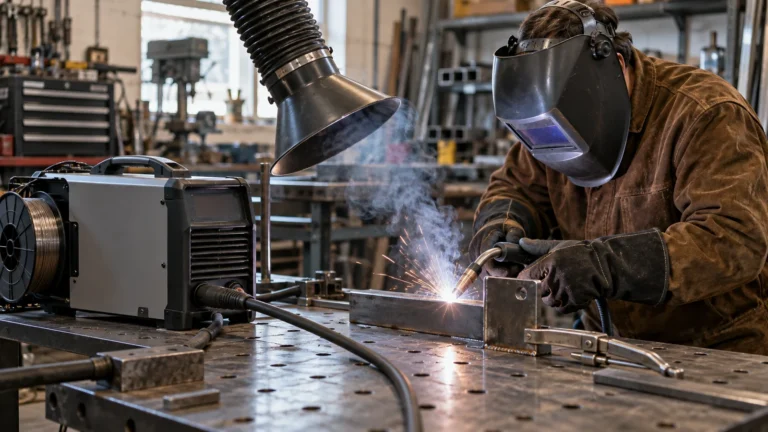
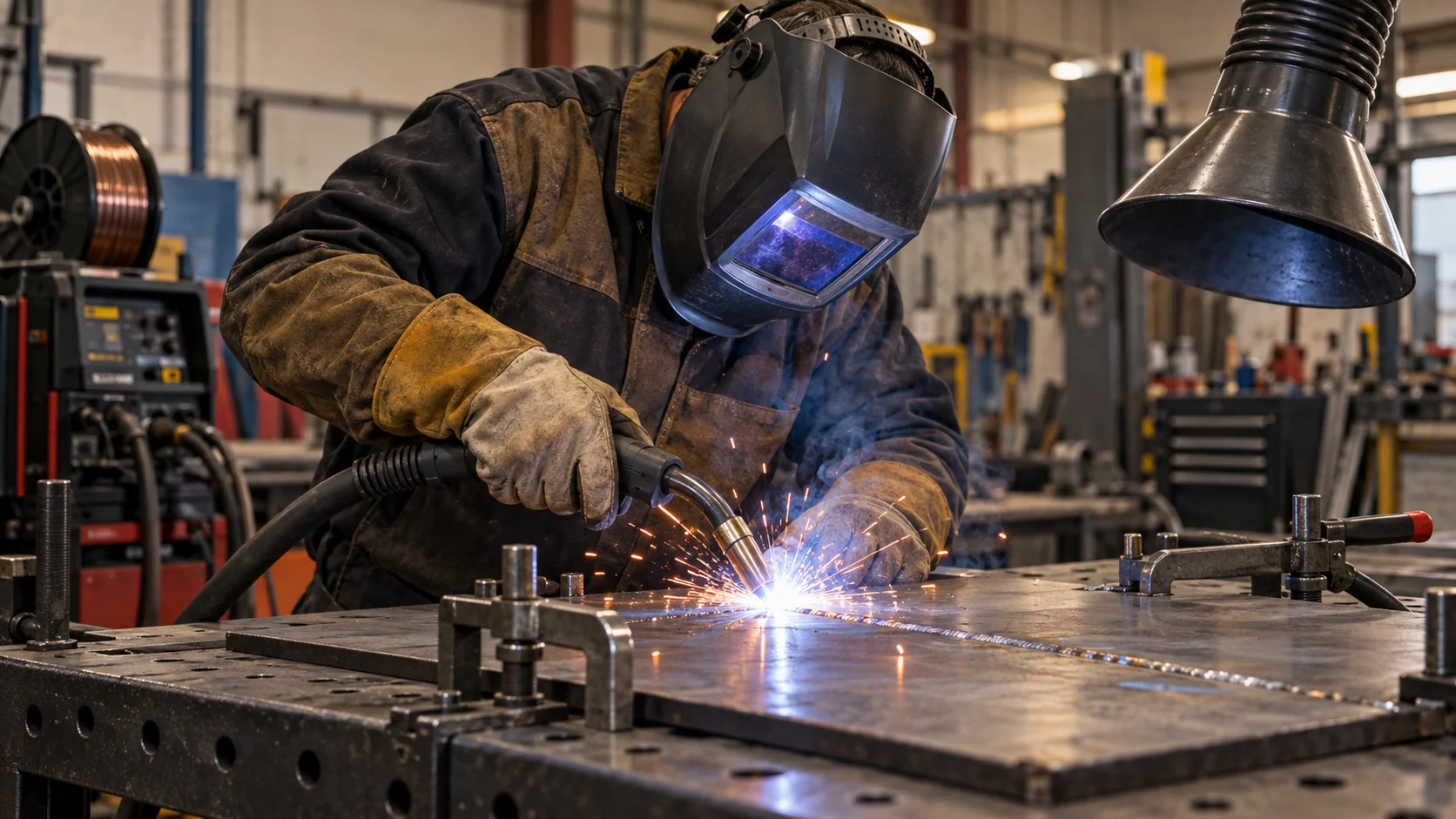
A wire feeder pushes a consumable electrode through the gun while an electric arc melts the wire and base metal. Unlike solid MIG wire, the electrode has a flux-filled core. As the flux reacts in the arc, its ingredients assist shielding, stabilize the arc and create protective slag on the deposited weld. The exact roles depend on the wire formulation. The slag must be removed where required, especially before another pass or visual inspection.
The shared wire-feed hardware makes FCAW look like MIG welding, but the processes are not interchangeable at the spool level. A welder advertised as “MIG/flux-core” may support self-shielded wire yet lack the gas hardware or output range needed by a gas-shielded flux-cored product. The machine manual and the wire data sheet, not the marketing label alone, determine the setup.
Self-shielded vs. gas-shielded flux-core welding
| Decision | Self-shielded FCAW-S | Gas-shielded FCAW-G |
|---|---|---|
| Shielding | Flux system supplies the required protection; no external gas cylinder. | Flux plus an external gas selected for the exact electrode. |
| Typical setting | Outdoor repairs, field fabrication, places where a gas cylinder is impractical. | Controlled shop work, production and thicker fabrication when the procedure specifies it. |
| Wind | More tolerant of air movement than gas-dependent wire, but not immune to unsuitable weather or contamination. | Air movement can disrupt gas coverage; shielding conditions must be controlled. |
| Setup | Compatible power source, correct wire and feed system, specified polarity. | All of the self-shielded checks plus gas-capable hardware, cylinder, regulator and specified gas flow. |
| Cleanup | Slag and spatter may require removal. | Slag still forms; removal and inspection remain necessary. |
The consequential distinction: “flux core” does not mean “gasless.” A gas-shielded electrode cannot be made self-shielding by simply disconnecting the cylinder. Likewise, adding gas to a self-shielded wire does not automatically improve its performance. Use the shielding method listed for the exact wire classification and manufacturer product.
For thin automotive body panels, aluminum jobs or appearance-sensitive clean sheet metal, flux-core may be the wrong process. Thin-gauge burn-through risk, cleanup and material-specific filler selection can favor a different machine/process. Do not buy a spool of ordinary steel flux-cored wire for aluminum.
Before buying a spool: the compatibility checks that matter
Wire diameter alone is an incomplete specification. Read the complete wire designation and product sheet, then check these items against your welder and intended joint:
- Shielding type and approved gas: confirm FCAW-S or FCAW-G. Gas-shielded products specify their applicable gas, which may differ between wires.
- Polarity: many small self-shielded wires call for DC electrode negative (DCEN), while many gas-shielded wires use DC electrode positive (DCEP). Neither rule replaces the electrode’s own instructions. Changing polarity incorrectly can ruin the arc and weld quality.
- Wire diameter and output: verify that your machine can run the electrode’s diameter within its recommended operating range. A spool fitting on the hub proves nothing about sufficient output.
- Feeder, contact tip and spool: match drive-roll type, wire guide, contact-tip size, spool dimensions and liner to the machine’s manual. Many flux-core setups use knurled rolls; the correct groove still depends on the particular wire and feeder.
- Welding position and passes: not every flux-cored electrode is approved for all positions or multipass work. A visually acceptable practice bead is not proof that a wire meets a structural specification.
For example, Hobart E71T-11 self-shielded carbon-steel wire in a 0.030-inch, 2-pound spool is a concrete example of a small-spool FCAW-S consumable, not a universal recommendation. Verify the exact product variant, available spool capacity, polarity and your welder’s supported wire size before purchasing. View the Hobart E71T-11 wire on Amazon
If you are considering a different wire, compare the full printed specification rather than assuming that two spools marked 0.030 inch can be swapped without changing settings, polarity or application limits.
A safer first setup for self-shielded flux-core welding
These are setup checkpoints for a suitable machine and approved wire, not a substitute for the machine’s installation manual, electrode operating sheet or supervised training. Stop if the outlet, wiring, work connection, machine condition or ventilation is in doubt.
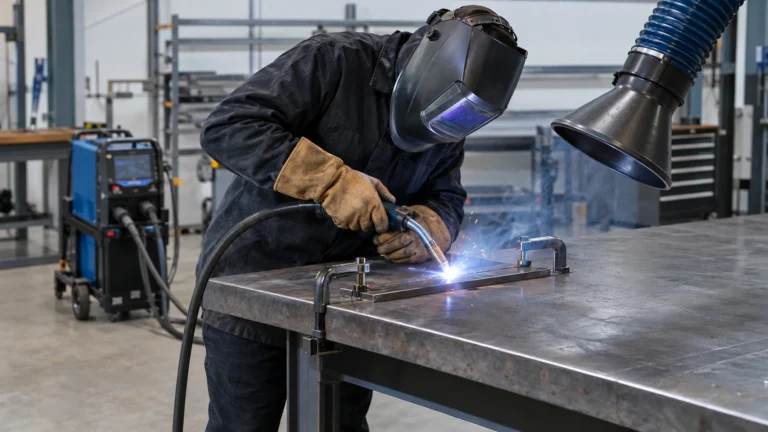
- Make the work area safe. Remove combustible materials, protect bystanders from arc radiation, secure the workpiece, plan a fire watch where appropriate and arrange effective fume capture. Never weld on an unknown tank, drum or potentially contaminated vessel.
- Identify the base material. Confirm that you are working with an appropriate weldable steel and a permitted joint. Painted, galvanized, plated and unknown-coated materials can release hazardous contaminants; do not proceed without a suitable assessment and controls.
- Check the machine while de-energized. Inspect the lead insulation, gun, contact tip, drive components and work clamp. Use the owner’s manual for safe access and maintenance; never modify live terminals or bypass guards and interlocks.
- Match wire and polarity. Load the manufacturer-approved spool, roll and tip size. Set polarity exactly as the chosen wire requires, using the manufacturer’s procedure.
- Start from documented settings. Use the machine chart and the specific electrode’s voltage, wire-feed-speed and contact-tip-to-work-distance guidance. There is no safe, reliable universal chart for every flux-cored wire and steel thickness.
- Run practice beads on similar scrap. Clean the joint surfaces, clamp the work and practice in the specified position. Keep the gun angle and travel method consistent with the wire’s instructions; many self-shielded wires favor a drag technique, but check the actual electrode.
- Let the weld cool safely, remove slag and inspect. Wear eye and hand protection against flying chips and hot metal. Check for visible discontinuities and adjust based on the manual, not guesswork. Critical load-bearing work requires a qualified welding procedure and any mandated inspection.
A common first-day mistake is trying to fix every rough bead by turning up the voltage. If the wire is feeding inconsistently or the polarity is wrong, a higher setting does not solve the root cause. Verify fundamentals before adjusting welding parameters.
Technique: what changes the bead and what to check first
Travel direction, stickout and work angle
Self-shielded wires are frequently used with a drag or pull technique that keeps the solidifying slag behind the arc. Maintain the angle and electrode extension recommended for the specific wire, especially if moving from solid MIG wire. Excessive or unstable stickout changes the electrical behavior at the arc and can produce inconsistent results. Do not copy a generic internet stickout number across wire families.
Cleaning is still necessary
Flux chemistry can make the process more tolerant of modest surface contamination than gas MIG, but rust, oil, moisture and coatings still compromise weld quality and may create dangerous fumes. Clean to the applicable welding procedure. After welding, remove the slag with appropriate eye protection and inspect the bead before another pass. A slag chipping hammer is useful here, rather than relying on the gun to do cleanup work. See an Estwing E3-WC slag hammer on Amazon
Wire feeding problems often imitate bad settings
Birdnesting near the drive rolls, uneven feed and repeated tip burnback can come from excess drive pressure, an incorrect roll groove, a damaged liner, mismatched contact tip or a kinked gun cable. Switch the machine off and follow its maintenance instructions before inspecting feed components. Do not tighten the feed mechanism indefinitely to force a problematic spool through the gun.
Dedicated welding pliers can help trim the wire and remove spatter from a cooled gun nozzle. They are a convenience, not a substitute for matching the tip and roll to the wire or for servicing a damaged liner. Check Lincoln Electric K4014-1 welding pliers on Amazon
Diagnose the symptom before changing everything
| What you notice | Useful first checks | When to stop |
|---|---|---|
| Erratic feed or jerky arc | With power off, verify roll and tip size, spool drag, liner condition and correct feed tension per manual. | If leads are damaged, electrical parts are exposed or the drive continues malfunctioning. |
| Porosity or visibly contaminated weld | Review wire shielding type, condition and storage, joint cleanliness, specified technique and any required gas supply. | When coatings or the base material are unknown, or when the weld’s service requires inspection. |
| Excessive spatter and unstable sound | Confirm electrode polarity and machine chart, then review wire feed, stickout and travel consistency. | If correcting documented basics does not restore a stable process; use qualified service or instruction. |
| Slag inclusions between passes | Follow the procedure for removing slag and cleaning the joint before subsequent passes. | If the joint is load-bearing or specified by a code, follow the qualified WPS and inspection plan. |
A pretty surface is not a destructive or nondestructive weld test. Visible bead shape alone cannot establish penetration, fusion, mechanical strength or fitness for a safety-critical repair. For vehicle suspension, lifting attachments, pressure systems or primary structural components, use appropriately qualified personnel and the applicable procedure.
Flux-core welding safety: the limits of “gasless”
Gasless refers only to the absence of an external shielding-gas cylinder for FCAW-S. It does not mean fume-free. Flux chemistry, alloying elements, base metal and coatings all affect the airborne hazards. Use appropriate local exhaust and ventilation based on exposure conditions, keep your head out of the plume, and apply a formal respiratory-protection assessment when required. An open garage door is not automatically sufficient fume control.
- Arc and heat: wear a suitable welding helmet with properly selected shade, safety glasses, flame-resistant clothing, appropriate leather gloves and footwear. Protect nearby people from UV and IR exposure and sparks.
- Fumes: avoid welding galvanized, painted, lead-bearing or unknown-coated parts without a competent hazard assessment and controls. Never treat a basic disposable dust mask as universal welding-fume protection.
- Shock: keep gloves, work area and electrical equipment dry, inspect insulated cables and use the input circuit recommended in the welder’s manual. Leave electrical repairs to qualified personnel.
- Fire: clear combustibles, account for sparks traveling outside your direct view and follow hot-work and fire-watch rules applicable to the site.
- Confined spaces: do not begin welding in a tank, pit or enclosed vessel without the required hazard evaluation, ventilation, attendant and rescue arrangements. Routine hobby setup advice is not adequate for confined-space entry.
OSHA’s welding and cutting rules distinguish routine ventilation needs from stricter requirements for certain metals, coatings and confined spaces. That distinction matters more than whether your welder came with a gas hose.
When flux-core is the wrong choice
Choose self-shielded FCAW when outdoor steel work and portability matter, the wire and machine are genuinely compatible, and the job is within your training and applicable welding requirements. Consider gas-shielded FCAW for a specified shop-fabrication procedure with the correct gas, output and feeder. Choose another process or do not weld yet for unsupported aluminum jobs, very thin appearance-sensitive sheet, an unidentified alloy, uncontrolled fumes, inadequate electric supply or a safety-critical joint without an approved procedure.
The most useful purchase is often the correctly classified spool, not a new welding machine. Before spending on either, compare the electrode sheet, your machine manual and the actual work to be done.
Frequently Asked Questions
Is flux-core welding strong enough for structural work?
It can be when the filler classification, joint design, qualified welding procedure, welder qualification and inspection meet the relevant requirements. The process name alone proves nothing about strength. Do not use a practice bead to validate a load-bearing repair.
Does all flux-core welding use DC electrode negative?
No. Many small self-shielded electrodes use DCEN, but gas-shielded products often specify DCEP, and individual wire instructions control. Match the exact spool and equipment before changing polarity.
Can flux-core welding be done outside in the wind?
Self-shielded FCAW is generally less dependent on still air than external-gas MIG or FCAW-G. Severe wind, wet conditions, contamination and electrical hazards can still make the job unsuitable. Follow the wire and welder instructions and stop if shielding or site safety cannot be maintained.
Is flux-core welding safe indoors without a gas bottle?
Not automatically. The absence of a cylinder does not remove welding fumes, arc radiation, fire or shock risks. Appropriate ventilation or local extraction, PPE and an assessment of the material and coatings are still needed.