
GearAndSteel is reader-supported. As an Amazon Associate I earn from qualifying purchases. When you buy through links on our site, we may earn an affiliate commission, at no extra cost to you. Learn more.
The best welding fume extractor depends on how you capture smoke, not which machine advertises the largest CFM number. For close-range nozzle extraction at one light-duty welding station, the Lincoln Electric X-Tractor Mini K3972-5 is the more focused choice. For a movable hood serving a larger work area, consider the Everlast Cyclo-Air S750, provided its power and filtration fit your exposure-control plan. Neither is a substitute for a properly assessed ventilation system.
Our picks at a glance
These recommendations are based on published manufacturer documents and current product listings, not hands-on testing or measured exposure reductions. A product page showing an extractor does not establish that a particular installation keeps worker exposure below applicable limits.
Lincoln Mini vs. Everlast S750: what actually changes
| Decision point | Lincoln X-Tractor Mini K3972-5 | Everlast Cyclo-Air S750 |
|---|---|---|
| Capture style | High-vacuum hose and close-positioned EN 20 nozzle | Higher-volume flexible hose and funnel hood |
| Published airflow | Lincoln lists 95/108 CFM for its X-Tractor Mini platform at low/high settings | Everlast lists up to 442 CFM, a different extraction architecture |
| Power | 120 V single phase, 60 Hz; Lincoln lists 12 A input for K3972-5 | Manufacturer lists 240 V, with a separate 120 V option; confirm listing variant |
| Maintenance concern | Model-specific filters, hose/nozzle compatibility and motor-brush service | Cleanable first-stage mesh and downstream filter management |
| Main reason to skip | Need a distant hood over a large work area or expect the sensor to trigger at low current | Need documented fine-particle capture beyond its specified filter rating or only have an incompatible supply |
Do not rank these machines by 108 versus 442 CFM. High-vacuum systems move air through relatively small nozzles and hoses; high-volume systems use larger openings. Airflow measured at the machine does not tell you the actual capture velocity at your weld, especially once hose resistance, hood placement, cross-drafts and filter loading are involved.
Lincoln Electric X-Tractor Mini K3972-5
Choose it when your welding station lets you place a compact nozzle near the fume source and you want one transportable high-vacuum extractor.
The defining advantage here is the capture point. Lincoln’s K3972-5 package includes its EN 20 nozzle, so a buyer is not left with a hose but no suitable inlet. The company describes this family as equipment for light-duty welding fumes, not a substitute for a production-shop engineered extraction system. The 8-foot extraction hose supports a nearby station; routing it around a large fabrication bay defeats the reason to buy a close-capture machine.
There is a small specification with an outsized consequence: Lincoln’s instruction manual says the automatic current sensor needs at least 50 amps to activate. If you frequently run low-current TIG, do not count on sensor-triggered starts. Plan to operate the machine according to its manual rather than assuming the fan is running because the torch is active.
Skip this model if you need a large capture hood spanning a wide bench, you cannot position the nozzle where fumes originate, or you cannot accommodate its specified electrical input. Check the actual cartridge and replacement supply before purchase. This is a serious ongoing cost, not an optional afterthought.
Everlast Cyclo-Air S750
A better match when you want to move a flexible funnel hood around a small fabrication station rather than work through a narrow nozzle.
Everlast describes the S750 as a compact, wheeled welding fume collector with a poseable hood, adjustable speed and a progressive three-stage filter. A cleanable mesh first stage is a practical advantage in a shop where debris loads the intake: service routines matter because a clogged system can lose effective capture.
The crucial limitation is filtration language. Everlast states up to 95% filtration for particles down to 0.5 micron. That is not an independently established HEPA rating and should not be presented as one. If the plan depends on returning cleaned air to an occupied shop, have the selected system and actual welding contaminants assessed, including what its filter does not remove.
Skip it if only a standard 120 V supply is available and you have not verified that the exact Amazon variant is 120 V. Also skip the assumption that a big hood will capture a plume from anywhere on the bench. Position and cross-drafts still determine what reaches the welder’s breathing zone.
How to choose a welding fume extractor that will actually suit your shop
1. Start with the weld, not the catalog CFM
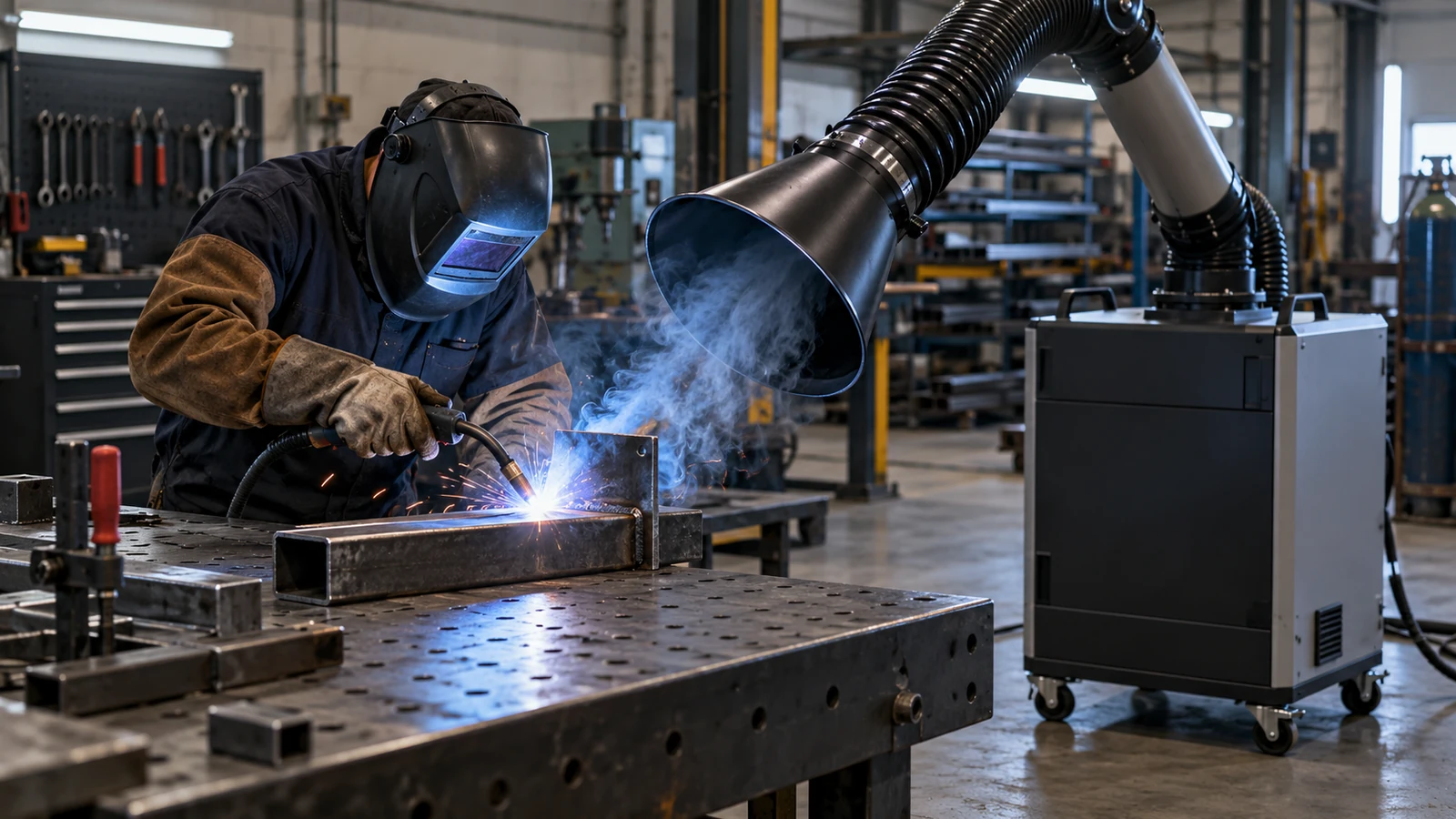
A small hose nozzle can work well for a fixed, accessible weld, but requires regular repositioning as the work moves. A large articulated arm or hood is easier to use around broad workpieces when it can be kept sufficiently close and out of the welder’s way. In either case, extraction that pulls a plume across your face before capturing it is poorly placed. OSHA’s ventilation guidance emphasizes local hoods positioned as close as practicable to the source and systems capable of controlling exposure.
2. Ask what the filter captures and what happens to the exhaust
Welding creates very fine particulate and can also release hazardous gases. A particle filter rating by itself does not prove removal of gases or guarantee safe air recirculation. Look for the exact published filter class or efficiency, a documented replacement schedule and instructions for handling contaminated media. Work involving stainless steel, coated metals, unknown coatings or potentially toxic constituents deserves hazard-specific controls rather than an improvised consumer fan.
3. Check power and the true cost of consumables
A 120 V garage outlet does not automatically make every 120 V extractor suitable for the branch circuit, especially when the welder and other tools share loads. Check the equipment nameplates and manuals and have an electrician address circuit questions. Before paying for an extractor, confirm you can still obtain its exact replacement filter and compatible hose. A collector with a full, neglected filter is not the bargain its initial purchase price suggests.
4. Decide whether you need a portable machine at all
Portable units make sense when one worker moves among small jobs or when permanent ductwork is impractical. For several simultaneous welding arcs, long-duration flux-core production or frequent high-hazard jobs, evaluate a designed extraction arm network, dedicated booths or other engineered controls. This page compares practical single-station products, not industrial ventilation design specifications.
Which setup makes sense for your work?
- Occasional MIG fabrication on mild steel at a fixed bench: a nearby, welding-rated source-capture unit may be practical if the inlet stays close, capture is checked and other required ventilation is provided. The Lincoln nozzle format fits the stationary task.
- Changing positions around small fixtures: a flexible hood such as the S750’s can be more convenient, as long as the hood’s position is maintained and the outlet and filtration are suitable.
- Low-amperage TIG work: confirm how the extractor starts. Lincoln’s 50 A sensor threshold may mean you need manual operation, following the official instructions.
- Stainless, galvanized, painted, plated or unknown material: stop and identify the material/coating hazards before hot work. Do not buy a filter based on a generic “removes smoke” promise. Seek a qualified industrial hygiene or safety assessment where appropriate.
- Confined spaces or oxygen-deficient atmospheres: neither of these products is a clearance to weld. Confined-space entry and hot-work procedures require specialist assessment, authorized controls and the applicable OSHA requirements.
The hidden purchase: replacement filters and compatible hoses
The purchase decision is incomplete until you know which consumables are available. Lincoln lists K2389-9 as an approved 8-foot replacement hose for the X-Tractor family and specifies limits on combined extraction-hose length. Do not fit an arbitrary shop-vac hose or stretch the line beyond manual limits to reach a distant bench. Check the Lincoln K2389-9 hose listing on Amazon.
Lincoln also markets a LongLife-H main filter (KP2390-1) for the Mini family. Filter names and revision compatibility matter; verify the filter part against your actual extractor serial/model and the current manufacturer parts instructions before ordering. Review the KP2390-1 filter listing on Amazon. Replace and dispose of contaminated media as the manufacturer and workplace hazard assessment require; never blast captured welding dust back into shop air with compressed air.
When neither extractor is enough
Stop welding and reassess controls if fumes visibly pass through the breathing zone, the hood cannot be placed near the source, filters are damaged or exhausted, airflow appears inadequate, or the material and coating hazards are unknown. Visible smoke reduction alone does not establish safe exposure. Employers may need exposure monitoring, engineered ventilation and a respirator program based on the specific job. Respirators, where required, supplement rather than replace properly selected engineering controls.
Do not use oxygen to ventilate a workspace. Keep extraction equipment and hoses clear of hot metal, sparks and physical damage, and follow manufacturer instructions on spark/fire protection. Mechanical ventilation, hot-work fire precautions, shielding gas and cylinder safety remain separate requirements even with a fume collector in place.
For a buying decision today: choose Lincoln’s K3972-5 when close nozzle capture and its specified electrical requirements fit a light-duty single station. Choose Everlast’s S750 when a movable hood is the better physical match and its power, filtration and exhaust arrangement have been checked. If those conditions are uncertain, buy neither until the controls are defined.
Frequently Asked Questions
Is a solder fume extractor enough for MIG or stick welding?
Do not assume so. Many desktop solder absorbers are intended for electronics smoke rather than metal-welding aerosols, sparks and the contaminants in welding fumes. Use equipment documented for the welding operation and have the ventilation arrangement assessed for actual exposure, not just visible smoke removal.
Can I compare welding fume extractors using CFM alone?
No. A high-vacuum nozzle and a high-volume hood serve different capture geometries. Rated air volume may be measured under conditions that differ from your installed hose, filter and hood position. Correct capture near the arc and the system’s documented filtration matter more than an isolated catalog figure.
Will the X-Tractor Mini start automatically during low-amp TIG welding?
Not necessarily. Lincoln’s X-Tractor Mini manual states its current sensor requires at least 50 amps of welding current. Below that threshold you should not assume automatic activation. Follow the model’s operating instructions to make sure extraction is running before beginning work.
Does a portable extractor eliminate the need for a welding respirator?
No universal answer applies. The need for respiratory protection depends on a hazard and exposure assessment, the material and process, the ventilation system and applicable workplace requirements. A portable collector is not proof of acceptable breathing-zone exposure, and filtration of particles does not establish removal of all welding gases.