
GearAndSteel is reader-supported. As an Amazon Associate I earn from qualifying purchases. When you buy through links on our site, we may earn an affiliate commission, at no extra cost to you. Learn more.
Welding safety starts before the arc. Identify the metal and any coatings, control fumes at the source, check the welder and power supply, remove fire hazards, and wear eye, face, hand, skin, and foot protection suited to the process. If you cannot control the air, electrical, fire, or gas hazards, do not weld. A helmet and gloves alone do not make an unsafe workspace safe.
Seven welding safety rules to check before striking an arc
For a first-time home-shop welder, the most useful safety routine is a go or no-go inspection, not a longer shopping list. The sequence below follows the different ways a welding job can go wrong. It also applies to quick tack welds: a brief arc can still expose skin and eyes, ignite combustible material, or release hazardous fume.
- Identify the work. Know the base metal, filler, coatings, residues and what is on the other side of the joint. Unknown paint, plating or contamination is a stop sign until the hazards and required controls are established.
- Control the air. Assess fumes and gases, then use an appropriate capture and ventilation method. Keep your head out of the plume. A visible opening or an ordinary fan is not proof of safe exposure.
- Check power and leads. Follow the specific welder manual for input supply, protection, machine grounding, cables and work connection. Disconnect and refer damage to qualified service personnel.
- Make the area fire-safe. Remove or protect combustibles, inspect adjacent spaces and hidden sides of metal panels, and have suitable extinguishing equipment ready.
- Protect everyone in range. Wear proper filtered eye and face protection, safety glasses where impact hazards exist, welding gloves, protective clothing and footwear. Set up suitable screens for bystanders.
- Secure equipment. Stabilize the workpiece, route hoses and leads away from feet, secure compressed-gas cylinders, and keep valves, hoses and regulators suitable for the gas system.
- Plan the finish. Treat recently welded metal as hot, follow the required post-work fire watch and inspect for smoldering material before leaving.
Do not proceed if a critical safeguard is missing or you are unsure what is inside a previously used container, tank or pipe. Never weld on an unverified container that may hold flammable residue or vapor. These are jobs for an assessed and authorized procedure, not an improvised shop experiment.
What welding PPE actually protects, and what it cannot do
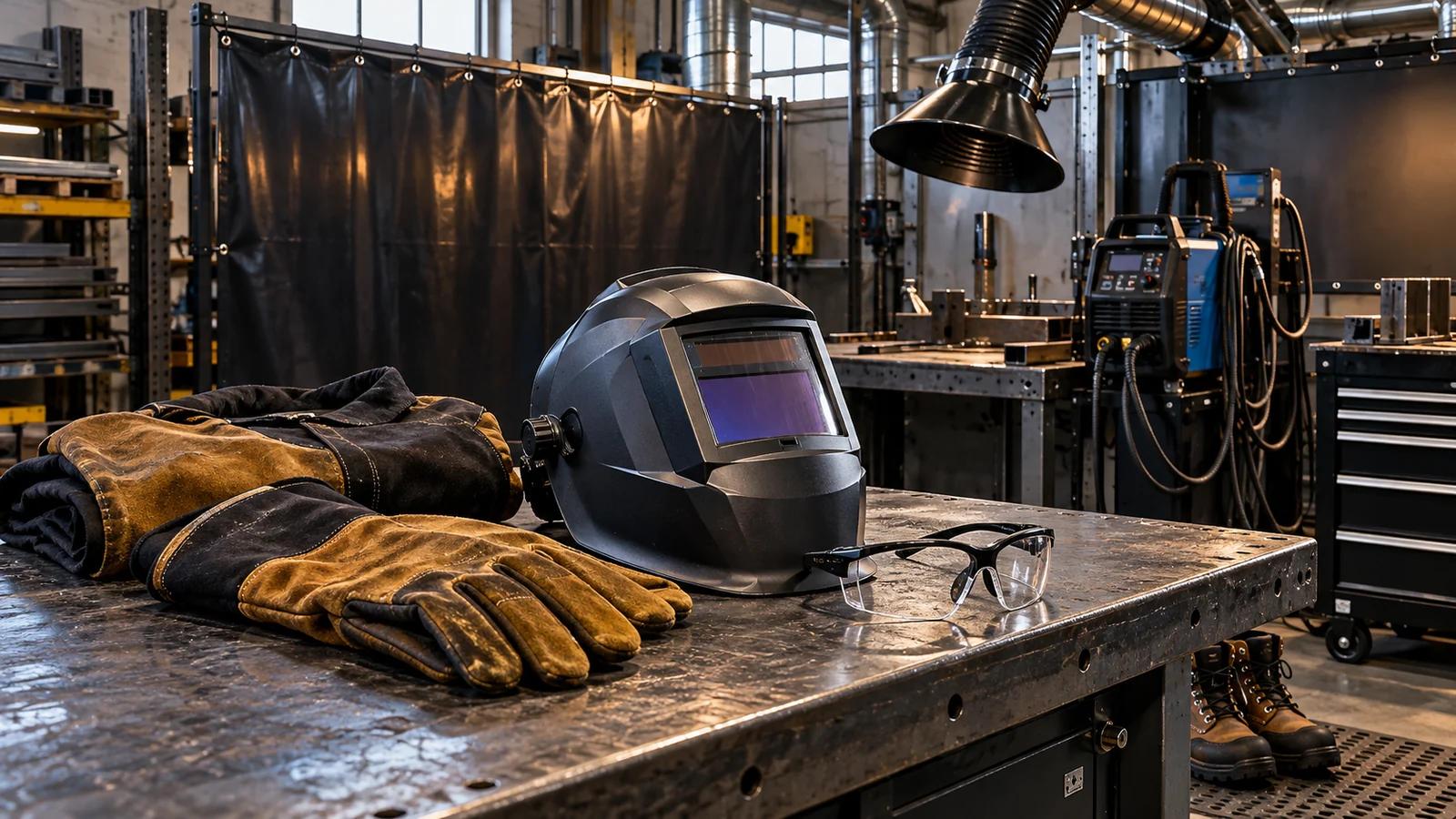
Different layers solve different problems. Arc radiation needs the correct filter and coverage; flying particles require impact protection; spatter needs heat-resistant garments; fumes require exposure control. Treating a generic face covering as a replacement for this whole system creates an avoidable gap.
| Protection | Main job | Important limitation |
|---|---|---|
| Welding helmet with appropriate filter | Protects face and eyes from arc radiation and spatter during arc work | Shade, coverage and operating mode must suit the actual process; clear safety glasses do not replace it |
| Impact-rated safety glasses with side protection | Protect against chips and particles during preparation, chipping and related work | Clear lenses are not appropriate arc-viewing filters |
| Welding gloves | Reduce burns and spatter exposure at hands and wrists | Different heat and dexterity demands for TIG versus MIG/Stick; gloves do not make hot metal safe to grab |
| Welding jacket or suitable protective clothing | Covers arms, torso and skin from UV and sparks | Open collars, rolled sleeves, exposed skin and unsuitable synthetic fabrics can defeat coverage |
| Appropriate footwear and leg coverage | Reduces burns from falling sparks and metal, and impact to feet | Exposed shoe openings and turned-up cuffs can trap sparks |
| Welding screens or curtains | Protect nearby people from arc radiation and some spatter | Must be appropriate for the application and must not block necessary ventilation |
Helmet: filter selection matters more than the size of the window
For arc welding, use a welding helmet or hand shield with a suitable filter shade selected for the process and current using the applicable safety guidance and the helmet instructions. A clear grinding mode is not an arc-welding mode. Check that the lens, cover plates and headgear are intact, and check auto-darkening operation according to the manufacturer before use. If the filter fails its check or is damaged, stop.
The YESWELDER LYG-M800H auto-darkening helmet is a concrete example of a multiprocess helmet to evaluate. The manufacturer lists an adjustable shade system and auto-darkening filter self-check. It is not a universal recommendation: verify the exact model, instructions, fit, approved applications and suitable shade for your job rather than relying on the product photo.
Check the YESWELDER LYG-M800H helmet on Amazon
Gloves: match the spatter load and the control you need
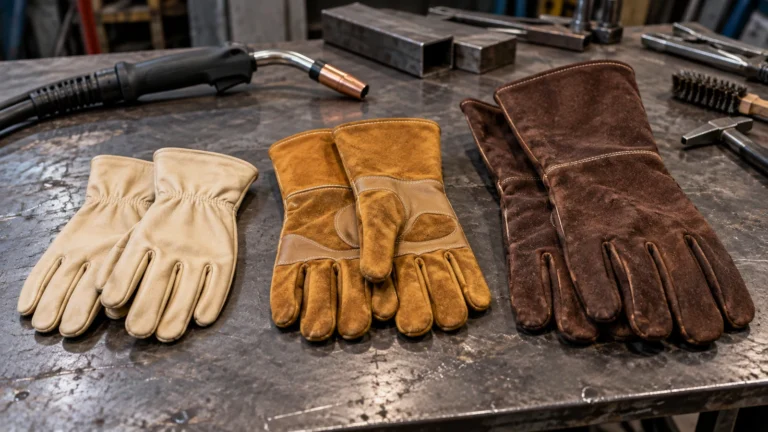
Thicker insulated welding gloves suit higher-spatter processes better than thin dexterity-first gloves; lighter TIG gloves can offer more fingertip control but are not the right substitute for demanding flux-core or stick work. The American Welding Society specifically distinguishes fine-control TIG applications from heavier MIG and stick work when selecting glove materials and coverage.
TOPDC’s 16-inch leather welding gloves are marketed for MIG and stick use, making them a possible starting point for a spatter-focused glove search. This is a selection example, not an independently tested heat rating. Check fit, seams, cuff coverage, garment overlap and the current manufacturer’s labeling before buying. Replace worn or damaged gloves.
View TOPDC MIG/Stick welding gloves on Amazon
Do not confuse gloves with permission to touch a hot workpiece. Use suitable handling tools and allow cooling; a finished bead may look cool while remaining hot enough to burn through protection.
Welding fumes: solve the exposure, not just the smell
Welding fume is a mixture whose hazards depend on the process, filler, metal and coatings. Ordinary mild steel is not automatically harmless. Stainless steel, galvanized or zinc-coated metal, painted or lead-coated material, and other alloys can introduce additional serious exposures. The National Institute for Occupational Safety and Health emphasizes controls such as local exhaust ventilation and material assessment rather than relying on whether a plume looks small.
A practical ventilation decision
- Known, clean metal in a properly assessed setup: use the ventilation controls required for that task, which may include correctly positioned local exhaust capture. Keep fumes from passing through the breathing zone.
- Uncertain coating, alloy or residue: stop and identify the material and applicable hazard controls first. Do not simply grind an unknown coating or assume outdoors is enough.
- Work in a tank, pit, vessel or restricted enclosure: do not improvise. Confined-space welding involves ventilation, atmosphere, rescue and gas-displacement hazards that need a properly managed procedure and trained personnel.
- Ventilation cannot adequately control exposure: use a qualified occupational respiratory-protection assessment and the respirator program required for the conditions. A casual disposable mask selection cannot establish protection.
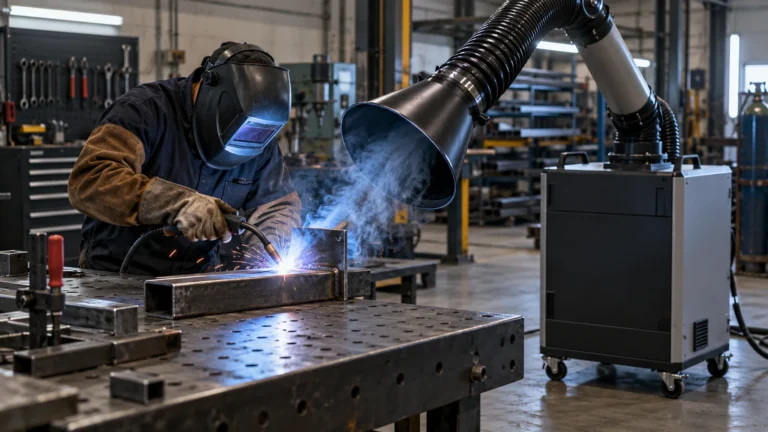
A fume extractor captures contaminants close to the work. It is not the same thing as a fan that happens to move air around a garage. Its effectiveness depends on capture position, airflow, process and maintenance. Source control often does more for the entire shop than purchasing more personal gear.
Stop-work triggers: uncharacterized fumes, ineffective capture, persistent buildup, or symptoms such as breathing difficulty, chest tightness, fever or unusual coughing after exposure. Stop work, leave the affected area, and seek appropriate medical assessment for symptoms. Do not resume solely because the air looks clearer.
Electrical safety: avoid the unsafe power shortcut
Arc welding equipment can present serious electric-shock hazards even when a welding machine looks compact. Match the welder to its specified power source and follow the manufacturer’s installation, grounding and cable requirements. A work lead attached to the part completes the welding circuit; it is not a substitute for the machine’s required protective equipment grounding.
- Before use, visually inspect accessible cords, insulation, connectors, electrode holder and the work connection. Keep leads away from wet floors, sharp edges and vehicle traffic.
- Keep yourself and gear dry. Do not operate damaged or wet equipment. Never hold an electrode or contact energized live components while in contact with the work.
- Do not use improvised extension cords, outlet adapters, modified plugs, bypassed interlocks or guessed breaker sizes. Electrical supply changes need evaluation by a qualified electrician.
- If the welder trips protection, gives a shock, shows exposed conductors or develops a burnt smell, turn it off safely, isolate power and arrange qualified inspection. Do not remove covers or probe live circuits to hunt the fault.
OSHA’s arc welding provisions separately address machine grounding, supply connection and condition of cables. This distinction matters particularly with portable machines: portability does not make an unknown household circuit suitable.
Fire prevention: inspect beyond the part you can see
Sparks and heat can reach rags, solvents, cardboard, wood dust, insulation, openings in floors, and materials on the reverse side of a wall or sheet. Start by moving the work or combustibles to a safe location. When relocation is impossible, proper hot-work barriers and fire prevention procedures are necessary; a blanket is not permission to weld in a hazardous area.
Under OSHA’s general-industry hot-work provisions, a fire watch is required for defined conditions, including certain combustible exposures within 35 feet, and the watch continues for at least 30 minutes after the work where those provisions apply. Those are regulatory conditions, not a universal claim that 35 feet is always a safe distance or that all fires are impossible after 30 minutes. Site permits, current fire codes and the actual hazard assessment may require additional precautions or longer monitoring.
Never weld a used tank, drum, fuel container or pipe with uncertain previous contents. Cleaning, testing, isolation and authorization are specialized safety work. The visible outside of a container cannot prove that its internal atmosphere is safe.
Shielding gas, compressed cylinders and hidden exposure
Gas-shielded MIG and TIG equipment adds cylinder, pressure, hose and oxygen-displacement hazards. Secure cylinders against tipping using suitable racks or restraints, protect valves in storage and transport, and use components specified for the gas and regulator. Follow supplier and equipment instructions for leak checks and shutoff. Never repair a cylinder valve yourself or use oxygen to ventilate a workspace.
In enclosed or poorly ventilated spaces, shielding gases can displace breathable air without a useful odor warning. If your work area cannot be evaluated and ventilated safely, do not weld there. Combustible-gas cutting setups introduce further separation, flashback-prevention and fuel-gas procedures beyond this introductory arc-welding guide.
What changes with MIG, TIG and stick welding?
| Process | Where beginners often misjudge risk | Safety decision |
|---|---|---|
| MIG / GMAW | Assuming shielding gas means clean air; underestimating spatter and cylinder hazards | Provide suitable fume capture, secure cylinders, protect skin and check equipment connections |
| Self-shielded flux-core / FCAW-S | Assuming no cylinder means no fumes; confusing lower setup complexity with lower exposure | Assess higher fume/spatter potential for the actual consumable; select heavier protection when indicated |
| TIG / GTAW | Favoring dexterity at the expense of skin coverage; assuming a small bead means no arc hazard | Use suitable filter and complete skin protection; assess base metal, gas and ventilation |
| Stick / SMAW | Exposure to hot electrodes, slag, spatter and fumes | Use suitable gloves, face and impact protection for slag cleanup, and safe electrode-holder placement |
None of these processes removes the need for a safe electrical supply, an appropriate eye filter or a fire-safe area. Exact requirements depend on the machine manual, consumables, exposure assessment and location.
A 60-second pre-weld check you can actually use
- Material: Is the alloy known, free of hazardous unknown coatings and suitable for the planned process?
- Air: Is effective control in place for the fumes and gases this job can generate?
- Electricity: Correct machine supply, intact leads, sound work connection and no wet or damaged equipment?
- Fire: Combustibles removed or effectively protected, reverse side inspected, fire-response plan ready?
- People: Correct helmet mode and filter, clothing, gloves, footwear and bystander screens?
- Gas and workholding: Cylinders secure, compatible hoses in good condition and workpiece fixed?
- Afterward: Hot-metal handling and required fire watch arranged?
If any answer is uncertain, stop and resolve it before starting. Buying gloves or a helmet fixes only one part of the safety system. Readers setting up a home shop should prioritize identifying hazardous materials, ventilation and correct electrical installation before upgrading convenience features.
Frequently Asked Questions
What is the most important welding safety rule for beginners?
Do not start an arc until the work area, metal, ventilation, electrical connections, fire controls and protective gear have been checked. Any critical unknown is a stop condition rather than a reason to weld more carefully.
Is a welding helmet enough to protect your eyes?
No. For arc welding, the helmet needs the proper filter shade and functioning cover plates. Impact-rated safety glasses may also be needed under the helmet for chips and particles. Clear safety glasses alone are not welding filters.
Can you weld safely with the garage door open?
An open door does not prove that fumes and gases are controlled. Safety depends on the process, metal and coating, where the plume travels, and the ventilation and exposure assessment. Local exhaust may be necessary.
Are welding fumes dangerous even when the steel looks clean?
Yes. Fumes can contain hazardous constituents from base metal and consumables without obvious coatings. Material identification and suitable exposure controls remain necessary, including for mild steel.
Do welding blankets eliminate the need for a fire watch?
No. Blankets or screens are only part of a fire-prevention plan. Where the applicable hot-work rules or site procedures require a fire watch and post-work monitoring, those duties remain in place.