
GearAndSteel is reader-supported. As an Amazon Associate I earn from qualifying purchases. When you buy through links on our site, we may earn an affiliate commission, at no extra cost to you. Learn more.
Plasma cutter air pressure is set by the specific cutter and torch, not by a universal PSI chart. Find the required pressure and airflow in your operator’s manual, then check the pressure at the specified point while air is flowing. A compressor that reaches the number on its tank gauge may still be too small to maintain it during cutting. Never exceed the cutter’s maximum inlet pressure.
What PSI should a plasma cutter use?
First identify which pressure the manufacturer is talking about. The pressure at the compressor tank, the pressure arriving at the cutter inlet, and the pressure controlled inside the cutter are not necessarily the same. Neither a torch’s internal setting nor a compressor’s maximum pressure should be substituted for the manufacturer’s inlet requirement.
Two documented machines show why an all-purpose 60 or 70 PSI recommendation can mislead:
| Exact cutter | Published air requirement | Where and how to check |
|---|---|---|
| Eastwood Versa-Cut 40 CNC (item 66725) | 5 to 7 CFM at 60 PSI | The Eastwood operating manual instructs the operator to set its pressure gauge to 60 PSI while air flows through the torch in TEST mode. |
| Hypertherm Powermax45 SYNC, cutting at 20 to 45 A | Minimum cutting supply: 450 SCFH (7.5 SCFM) at 85 PSI. Hypertherm calls for an optimal flowing inlet range of 110 to 120 PSI and a maximum inlet pressure of 135 PSI. | Hypertherm advises measuring inlet pressure after external filtration, while gas is flowing. Its automatic gas control handles the operating setting. |
Do not apply either row to an unrelated model. The Eastwood figure comes from a specific CNC version and its procedure. On the Hypertherm, 85 PSI is a minimum at a stated flow, not the recommended regulator setpoint. The 135 PSI value is a safety ceiling, not a target. This distinction matters more than a generic amp-to-pressure lookup table.
Some plasma cutters have built-in compressors or automatic pressure control. If yours does, follow that model’s air-supply and gas-test instructions instead of trying to force an external shop regulator setting.
How to set plasma cutter air pressure without guessing
- Find the exact model’s instructions. Record the inlet pressure range, gas or air flow requirement, maximum allowed inlet pressure, approved gas, and whether the cutter has an automatic regulator or an air-test mode. Check the manual revision and torch combination.
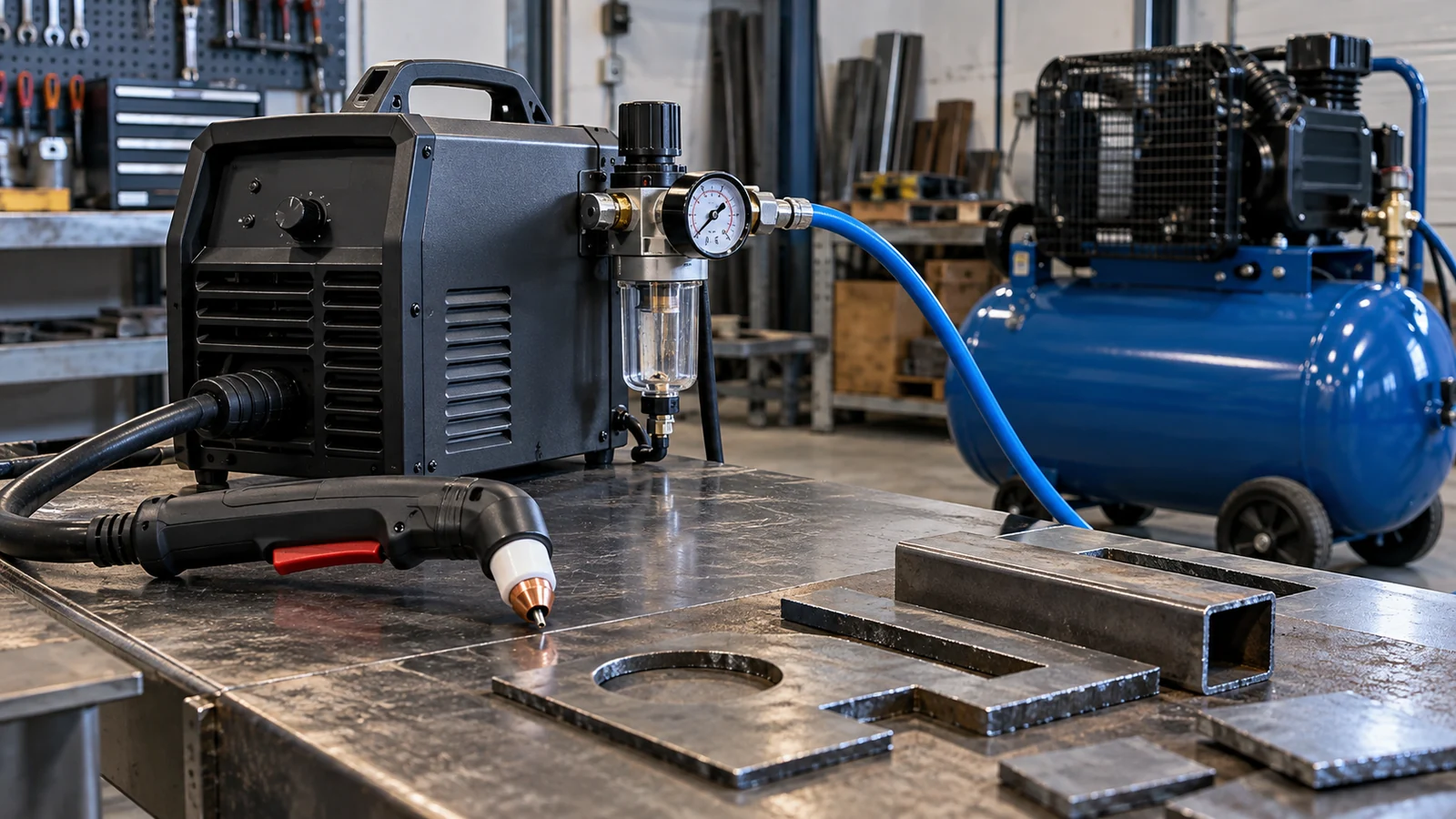
- Confirm the supply can deliver enough flow. Read the compressor’s delivered CFM or SCFM rating at the relevant pressure, not its maximum PSI or tank size. Account for other tools sharing that compressor.
- Check the complete air path. Use the hose length and inside diameter permitted by the cutter manufacturer. Inspect serviceable filters, drain moisture as instructed, and check approved fittings for leaks. Shut down and depressurize the system before working on pressurized components.
- Measure where the manual specifies. When the maker calls for a flowing measurement, use its built-in TEST, gas-check or purge function. For the Powermax45 SYNC, Hypertherm recommends an inlet gauge downstream of external filters. A regulator gauge beside the compressor may not reveal pressure loss in the line.
- Stop if pressure falls out of range. If pressure drops during an air test or cutting, do not compensate by exceeding an upstream component’s rating or the plasma cutter’s maximum inlet pressure. Investigate compressor output, restrictions and leaks using the manufacturer procedure.
On automatic-pressure machines, a successful inlet-pressure test does not mean you should manually override the torch’s gas control. If a pressure fault continues after the external supply meets the specification, use the model’s troubleshooting sequence or contact qualified service support.
Match compressor CFM to the pressure requirement
PSI tells you pressure; CFM or SCFM tells you how much air the compressor can supply. They must be considered together. A compressor rated at 6 CFM at 40 PSI is not automatically a 6-CFM compressor at 90 PSI. Look for the manufacturer’s delivered-air rating at a pressure that matches or exceeds the cutter’s relevant supply requirement.
For the Powermax45 SYNC example, Hypertherm publishes a cutting minimum of 450 standard cubic feet per hour. Dividing by 60 gives 7.5 SCFM at the specified 85 PSI minimum inlet condition. That conversion does not replace Hypertherm’s separate 110 to 120 PSI recommended flowing inlet range. Your compressor and air line still have to meet both the pressure requirement and required flow in the actual configuration.
A bigger receiver tank may make short cuts possible before the pump falls behind, but tank gallons cannot replace continuous pump output. If the pressure repeatedly sinks during longer cuts, the solution may be a higher-delivery compressor or a less restrictive air system, not a higher pressure setting.
Useful check: If a supply gauge reads normally at rest and dives only when air flows, suspect inadequate delivered CFM, a restrictive filter or fitting, an undersized hose, or a leak. If it remains stable but the cutter still cuts poorly, pressure alone may not be the cause.
Air pressure chart: what you can and cannot infer
A responsible plasma cutter pressure chart compares specific models and operating conditions. Amperage and workpiece thickness by themselves do not establish the correct PSI. For example, Eastwood’s published 40 CNC procedure calls for a 60 PSI flowing adjustment; Hypertherm’s Powermax45 SYNC automatically manages its gas setting while requiring a different inlet supply.
| Number you find | What it means | Common mistake |
|---|---|---|
| Minimum inlet PSI | Lower supply limit for a specified process and gas flow | Treating it as the ideal everyday setting |
| Recommended or optimal flowing inlet PSI | Pressure to maintain at the stated measuring point while gas is moving | Setting it on the compressor tank gauge with the cutter idle |
| Maximum inlet PSI | Upper safety limit at the cutter inlet | Using it as a performance target |
| CFM / SCFM / SCFH | Required flow, with reference conditions and pressure to be checked | Comparing compressor ratings taken at incompatible PSI values |
| Internal operating PSI | Pressure used or controlled by the cutter/torch system | Assuming it equals the required upstream air supply |
If a generic CUT-50 chart conflicts with your cutter’s manual, use the manual for your exact CUT-50 model, manufacturer and torch. CUT-50 is used on different products; it is not one standardized pressure specification.
Clean, dry air matters as much as the gauge reading
Compressed air can carry water, oil aerosols and particles. Hypertherm warns that contaminated air can harm internal components and shorten consumable life. It also warns that extra external filtration can reduce available pressure and flow. Filtration is useful only when correctly rated and maintained as part of the whole supply system.
For a shop with recurring moisture at the cutter, the Motor Guard M-30 is an example of a point-of-use compressed-air filter. Motor Guard’s 2026 product data lists a 1/4-inch NPT connection, a 125 PSI maximum pressure rating and a 45 CFM nominal flow rating. These are filter ratings, not proof that it will fit every cutter or meet a complete air-quality specification. Its 125 PSI maximum is especially important: do not install it where the supply could exceed that rating.
See Motor Guard M-30 filter on Amazon
If the compressor already has suitable drying and filtration, an additional inline filter may be redundant. Conversely, a point-of-use filter does not automatically solve heavy water carryover from an overloaded compressor or poor upstream moisture management. Confirm the component’s pressure rating, flow, fittings, service needs and actual pressure drop before buying.
When an external regulator is useful, and when to skip it
An external regulator makes sense if your cutter’s instructions require one and the compressor arrangement does not already provide an adequate, stable regulated supply. It is not a cure for too little compressor airflow. It can also add a restriction if poorly sized or installed.
The Milton 1114-8 is a 3/8-inch NPT high-pressure regulator with a manufacturer-published 10 to 250 PSI regulated range. Its wide range means that it can be adjusted above the safe inlet pressure of many plasma cutters. That makes verifying the downstream cutter’s maximum pressure and providing a suitable gauge and supply protection essential. Milton also specifies that a filter should precede the regulator. This is a component to evaluate against an existing shop-air design, not a universal plug-and-play plasma cutter upgrade.
Check Milton 1114-8 regulator on Amazon
Skip both accessories if your cutter has an approved integrated setup that already meets its air requirements, if you cannot verify connection and pressure ratings, or if the missing ingredient is compressor CFM. Ask the cutter manufacturer or a qualified pneumatic technician before modifying the air system when its safe operating limits are unclear.
Symptoms that look like a pressure problem
| What you notice | Check first | Do not assume |
|---|---|---|
| Gauge is normal at rest, falls during gas test | Flow capacity, hose restriction, filter pressure drop, leakage | That turning up tank PSI fixes insufficient CFM |
| Low-pressure alarm or cutter refuses to fire | Exact fault code, manufacturer inlet range, air-test reading and air quality | That the pressure switch should be bypassed |
| More dross or angled cut | Cut chart, travel speed, standoff, worn consumables, clean work connection, then verified air supply | That a pressure change alone will fix cut quality |
| Water at filter bowl or intermittent torch behavior | Drain/service the air system only according to its instructions; inspect drying capacity | That a replacement torch is the first purchase |
For persistent problems, use the exact manufacturer’s diagnostics. Stop immediately for damaged hoses, cracked filter bowls, air leakage that cannot be corrected safely, electrical faults, or pressure outside any rated component’s range. Never dismantle or service a pressurized line.
Safety limits before making a test cut
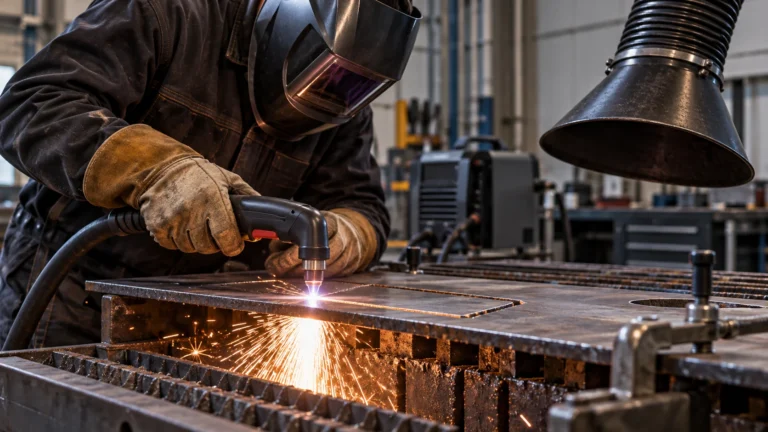
An air-pressure check is not permission to skip plasma-cutting precautions. Follow the cutter’s manual for eye and face protection against arc radiation, flame-resistant clothing, insulated gloves and footwear, secure work holding, work-return connection, ventilation and fire prevention. Protect bystanders from arc rays and sparks. Do not cut unknown coated or contaminated metals without an appropriate exposure assessment and controls.
During any external air-system inspection, stop the cutter, isolate its power where required and fully depressurize the air circuit before disconnecting parts. A regulator’s own maximum rating does not override a lower rating on its filter bowl, fitting, hose or cutter inlet. Never use oxygen as the compressed-air substitute unless the specific manufacturer explicitly approves that gas and its procedure.
The right setting is the one your system can maintain
Use the model’s specified flowing pressure at the specified measuring point, with enough delivered airflow to hold it. If you already meet those conditions, keep the air clean and dry and troubleshoot cutting technique and consumables before shopping for upgrades. If you cannot hold pressure under flow, address the compressor and air line rather than guessing a higher PSI.
Frequently Asked Questions
Should I set a plasma cutter to 60 or 70 PSI?
Only if that setting and measuring procedure appear in the instructions for your exact model. Eastwood specifies 60 PSI while air flows for its Versa-Cut 40 CNC. The Hypertherm Powermax45 SYNC requires a different inlet-air arrangement, so a copied 60 or 70 PSI setting could leave it under-supplied.
Should I adjust plasma cutter pressure for thicker metal?
Not automatically. Use the cut chart for the specific cutter, torch, consumables and material. Cutting current, travel speed and standoff may change with thickness while the proper air-pressure procedure may stay the same. Change pressure only if that manufacturer’s procedure or chart calls for it.
Why does pressure drop when the plasma cutter starts flowing air?
The compressor, air line, filter, regulator or fittings may not sustain the required flow. Compare delivered compressor CFM at the relevant PSI against the cutter’s specification and check permitted hose size, restrictions and leaks. Do not exceed rated pressure to hide the drop.
Can I use my plasma cutter with a small compressor tank?
A small tank can support brief use if the compressor meets the cutter’s required pressure and flow, but tank capacity is not a substitute for pump output. If the supply falls outside the manual’s range during the expected cut, pause and correct the air supply before continuing.