
GearAndSteel is reader-supported. As an Amazon Associate I earn from qualifying purchases. When you buy through links on our site, we may earn an affiliate commission, at no extra cost to you. Learn more.
For most mild-steel MIG welding, start with C25 shielding gas, a mix of 75% argon and 25% CO2. Pure CO2 is another option for steel, while aluminum MIG typically uses 100% argon. Stainless steel needs a blend selected for the filler wire and welding process. Before buying a cylinder, check your welder’s gas recommendations, wire type, regulator connection, and ventilation.
Choose MIG welding gas by the metal, not by the cylinder label
MIG welding gas protects the molten weld pool from surrounding air. It also changes how the arc behaves, how the bead wets into the joint, and how much spatter you can expect. That is why “argon is better” and “CO2 penetrates more” are incomplete buying rules. They ignore the metal, filler, transfer mode, and welder settings.
| Material and job | Practical starting point | What changes the decision |
|---|---|---|
| Everyday mild steel, including tubing and general repair | C25 (75% argon / 25% CO2) | Good short-circuit arc behavior and relatively manageable spatter. Confirm the welder supports the blend. |
| Carbon steel when gas cost and penetration matter | 100% CO2, if the welder, wire, and regulator support it | Usually more spatter and a less forgiving arc; different cylinder fittings may be required. |
| Aluminum MIG | 100% argon | Correct aluminum wire and compatible feed system remain essential. Argon/helium mixtures have specialized uses. |
| Stainless steel MIG | A manufacturer-approved, usually low-CO2 argon-rich or helium-containing blend | Wire classification, transfer mode, corrosion requirements, and the approved welding procedure determine the mixture. |
| Outdoor work with significant wind | Reconsider gas-shielded MIG | Air movement can disrupt gas coverage. A suitable self-shielded flux-core process may be preferable if approved for the job. |
Important: These are material-selection categories, not universal welding procedures. Structural, code-controlled, or critical stainless applications require an approved procedure and the relevant filler and shielding-gas specifications.
The three choices most welders actually compare
C25: the sensible default for solid-wire mild steel
For a typical small shop running solid ER70S-class MIG wire on carbon steel, C25 is a straightforward choice. Miller identifies 75/25 argon/CO2 as a common mixture that provides favorable arc characteristics and lower spatter than straight CO2. Less spatter can also mean less grinding around visible joints. That matters on thin tubing or automotive sheet where cleanup time and appearance are important.
C25 is not automatically the best gas for every steel transfer mode. High-argon blends are often chosen for conventional spray transfer, so do not assume a C25 cylinder enables the spray settings shown in another machine’s chart.
100% CO2: viable steel shielding, with a tradeoff
Straight CO2 can be attractive for compatible carbon-steel work because the gas itself is often economical and the process can produce strong penetration. The practical costs are a harsher arc, greater spatter, and possible extra cleanup. It is not a direct substitute for C25 at identical machine settings, and pure CO2 does not provide the conditions used for conventional argon-rich axial spray transfer.
The biggest purchasing trap is the hardware. A cylinder supplied for straight CO2 commonly uses a CGA 320 connection, whereas an argon or C25 cylinder commonly uses CGA 580. Check the actual cylinder valve and the regulator’s gas service and inlet designation. Never force a fitting, improvise an adapter, or assume a regulator calibrated for one gas reads another gas correctly.
100% argon: the usual aluminum MIG choice
Pure argon is the common shielding gas for aluminum MIG. Carbon-dioxide-bearing steel mixes such as C25 should not be treated as general aluminum shielding gases. An argon cylinder alone does not make a steel-focused MIG setup suitable for aluminum: the machine must support the application and the correct aluminum filler, drive components, and gun arrangement must be selected.
Argon by itself is generally a poor default for conventional MIG welding of mild steel. A smooth-looking arc is not proof that the gas and filler combination will produce the required weld properties.
What about stainless steel MIG gas?
“Stainless MIG gas” is not one universal cylinder. Lincoln Electric’s GMAW shielding-gas guide lists several mixtures for austenitic stainless fillers, including 98% argon / 2% CO2 and specialized helium-rich mixtures, depending on transfer mode and electrode. Some approved procedures instead use a small oxygen addition. The wrong blend can affect bead behavior and, in some applications, the corrosion performance of the weld.
Choose the stainless filler classification first, then use the wire manufacturer’s recommended shielding gas and the qualified welding procedure where required. Avoid copying a generic steel C25 setting into stainless work, especially for corrosion-sensitive parts.
Buying your first MIG shielding gas cylinder
Start with the material you weld most and the process your machine supports. For occasional mild-steel repair with solid wire, a C25 cylinder is usually easier to justify than several specialty mixes. If you only use self-shielded flux-core wire, you may not need an external shielding-gas cylinder at all.
- Ask the supplier for the exact mixture. “MIG gas” is not a standardized single composition; confirm C25, pure argon, pure CO2, or the required specialty blend by name.
- Check exchange and refill policies before choosing cylinder size. A low upfront cylinder cost may come with a lease, deposit, exchange restriction, or different refill arrangement. Availability and local terms vary, so universal dollar figures are not useful here.
- Budget for the complete gas path. The correct regulator or flowmeter, rated hose, compatible connections, and cylinder restraint are part of the setup. A hose included with one regulator is not proof it fits your welder’s gas inlet. Do not treat a marketing claim of universal compatibility as permission to interchange regulator fittings.
- Use the label, not paint color, to identify contents. Confirm the cylinder identification with the supplier, especially for exchanges or shared shop inventory.
Gas cylinders and refills are usually arranged through an authorized local gas supplier, not treated like interchangeable small Amazon accessories. Do not buy a regulator until you know which valve connection and gas service you actually have.
Regulator, flowmeter, and hose: the compatibility check that saves returns
A cylinder pressure gauge and a shielding-gas flow reading tell you different things. Cylinder pressure describes the supply; welding flow is normally expressed in cubic feet per hour (CFH or SCFH) or liters per minute. Changing the cylinder pressure reading does not directly tell you the gas coverage at the nozzle. On a flowgauge regulator, the delivery scale is calibrated for particular gas conditions; a flowmeter uses a flow tube and still needs the proper gas scale.
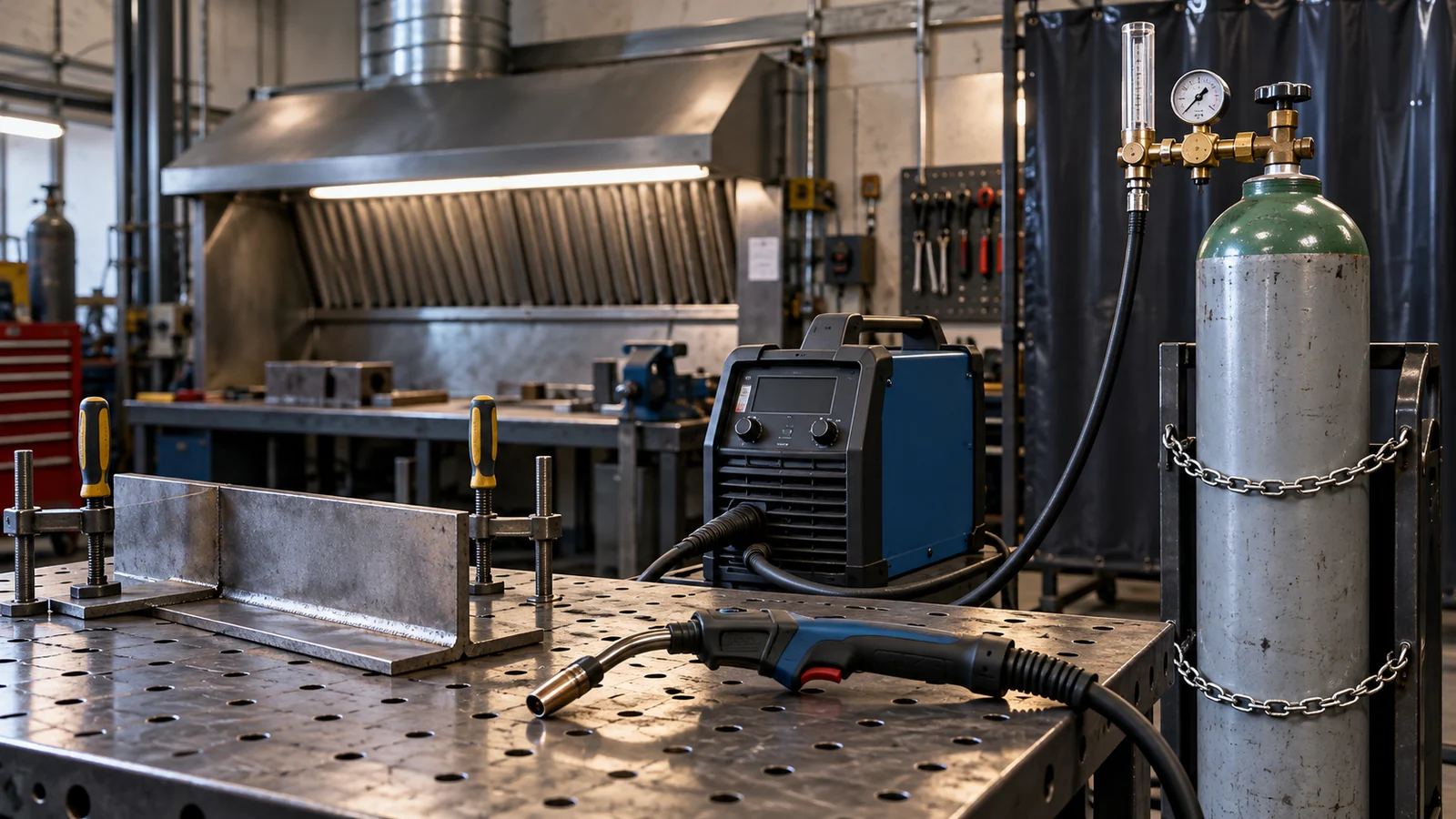
Before shopping, write down your cylinder’s valve connection, shielding gas, welder’s gas inlet, hose fitting, and the manufacturer’s approved flow-control arrangement. Two relevant Amazon examples illustrate why the small print matters:
YESWELDER flowmeter regulator with hose: consider it for an incomplete gas setup
The US Amazon listing for the YESWELDER Argon/CO2 flowmeter regulator with gas hose (B08LC41FTD) identifies a CGA 580 cylinder-side connection and describes use with argon and argon/CO2 mixtures. Its bundled hose can help when a welder did not ship with a gas hose, but you must check the welder-side fitting and the listing’s current kit contents. This is not a blanket recommendation for a straight-CO2 CGA 320 cylinder.
View YESWELDER regulator and hose on Amazon
BETOOLL argon/CO2 flowmeter regulator: compare it when the hose is already sorted
The BETOOLL argon/CO2 flowmeter regulator (B087F2FXQX) is another currently identifiable US Amazon listing in the same basic equipment class. Compare its documented inlet and outlet with your cylinder and existing hose rather than buying two regulators for one welder. A correct connection and gas calibration are more important than gauge appearance or a promise of a “universal” fit.
View BETOOLL flowmeter regulator on Amazon
Skip both examples if the cylinder uses a different connection, your gas supplier requires another regulator type, or the welder manual specifies different equipment. If your existing regulator is suitable and in good condition, there is no reason to replace it simply because you changed wire.
MIG gas flow rate: why more is not always safer
Some manufacturers describe starting flow ranges in the neighborhood of 20 to 30 CFH for specific solid-wire steel setups. That is a context-bound example, not a universal rate for every nozzle, joint, gas, or workshop. Consult the exact machine and consumable instructions. The regulator’s indicated flow may not equal the flow arriving at the torch if the hose is damaged, a connection leaks, or the gun has an obstruction.
Low flow can fail to protect the puddle. Excessive flow can waste gas and, in some setups, create turbulence that draws surrounding air into the shield. Drafts, an unusually long stickout, a dirty gas nozzle, or a poorly positioned gun can also spoil coverage. A larger CFH number cannot reliably correct those problems.
Practical diagnosis: If a previously sound weld suddenly develops scattered pinholes, stop and look for obvious drafts, a closed or depleted gas supply, a pinched external hose, and visible nozzle blockage, following the equipment manual. Do not open a pressurized regulator, disconnect live gas fittings, or investigate a suspected cylinder or regulator leak while continuing to weld. Isolate the equipment according to the supplier’s procedures and contact qualified service personnel when the problem is not a safe external check.
How to avoid wasting a cylinder
Gas consumption depends on actual flow while the trigger is supplying shielding gas, plus preflow, postflow, leaks, purging, and any other losses. A simple planning estimate is cylinder capacity in cubic feet divided by flow in CFH. For example, an illustrative 80-cubic-foot supply at a steady 20 CFH would equal 4 hours of continuous gas flow in an ideal, loss-free calculation. It does not mean four hours of arc time in real working conditions or guarantee that every cylinder contains its full nominal capacity at the start.
This estimate is useful for deciding whether cylinder size fits a project. It is not a way to set a safe operating pressure, and the example flow should never override your welder’s instructions.
Gas-shielded MIG vs self-shielded flux-core
They are often offered on the same multiprocess machine, but their shielding arrangements differ. Gas-shielded MIG with solid wire needs an external gas supply. Self-shielded flux-cored wire creates its own shielding system and is a practical candidate where outdoor wind defeats gas coverage. Not every flux-cored wire is self-shielded: some wires require external gas, and polarity and feed settings vary by classification.
If you weld mostly outside, decide between these processes before buying a cylinder. If you weld indoors on clean mild-steel parts and value a more controlled, less spattery appearance, C25 with suitable solid wire often makes sense. Neither process removes the need for fume control and protective equipment.
Cylinder and welding-gas safety are part of the purchase decision
Shielding gases can displace oxygen, particularly in poorly ventilated or confined spaces, even though argon and CO2 are not the same as a fuel gas. Welding itself adds hazardous fumes, UV/IR exposure, electric-shock risk, hot metal, and fire hazards. A shielding-gas cylinder does not make the air safe to breathe.
- Secure cylinders against falling, protect valves from impact, and follow the gas supplier’s handling and transport instructions. Keep cylinders away from the welding return-current path and where sparks or hot metal could strike them.
- Use only the regulator, hoses, and connectors approved for the gas and cylinder service. Never modify cylinder valves, refill or mix gases yourself, or use oxygen in place of shielding gas or as ventilation.
- Use appropriate welding eye, face, hand, and body protection and protect bystanders from arc radiation. Provide ventilation and source capture appropriate to the metal, coatings, consumables, and location.
- Do not weld on unknown coated metals or in a tank, pit, or other confined space based on a generic online gas-flow tip. Such work requires a formal hazard assessment and appropriate qualified procedures.
For workplace setups, applicable OSHA welding and compressed-gas rules and the American Welding Society’s safety guidance should be assessed against the exact operation. Stop if a cylinder valve, regulator, hose, or ventilation system is damaged, leaking, or of uncertain compatibility.
A short decision before you buy
Buy C25 when you primarily weld mild steel with compatible solid MIG wire and want an approachable all-around setup. Consider straight CO2 if your carbon-steel application, machine, and gas hardware support its tradeoffs. Choose pure argon for conventional aluminum MIG with suitable aluminum equipment. Verify a specified specialty blend for stainless or a qualified procedure. Then match the regulator to the actual cylinder valve, not the other way around.
Once the correct gas and fittings are confirmed, the Amazon-listed flowmeter-and-hose kit is one accessory path worth checking. A working, compatible existing gas system remains the better purchase than redundant equipment.
Frequently Asked Questions
Can I MIG weld mild steel with 100% argon?
It is generally not a good default for conventional solid-wire mild-steel MIG. Manufacturer gas guides favor argon/CO2 blends or CO2 for common steel work; pure argon can give unfavorable bead and arc behavior. Follow the filler and welding procedure rather than substituting gases.
What gas should I buy for a beginner MIG welder?
If the welder supports gas-shielded solid-wire welding and your projects are mainly mild steel, C25 is the usual starting point. Verify the machine’s gas support and the cylinder connection first. A self-shielded flux-core-only setup does not need a shielding-gas cylinder.
Does MIG shielding gas pressure mean the same thing as flow?
No. Cylinder or delivery pressure is not the same as the shielding-gas flow reaching the weld. Flow is commonly measured in CFH, SCFH, or L/min and depends on the regulator or flowmeter and the gas scale. Use your machine’s recommended operating instructions.
Why is my MIG weld porous even though the cylinder has gas?
A pressurized cylinder does not guarantee good nozzle coverage. Drafts, incorrect gas, leaks, clogged or damaged gas passages, or gun technique can contribute. Stop, perform only the manufacturer’s approved external checks, and have gas-system faults addressed by qualified personnel.