
GearAndSteel is reader-supported. As an Amazon Associate I earn from qualifying purchases. When you buy through links on our site, we may earn an affiliate commission, at no extra cost to you. Learn more.
For most first-time buyers who want actual gas-shielded MIG welding on a 120-volt supply, the Lincoln Electric Weld-Pak 90i MIG is a sensible starting point: it supports both solid-wire MIG and self-shielded flux-core. Choose the YESWELDER MIG-205DS PRO if you can use 240-volt power later and want more room to grow. The Forney Easy Weld 140 FC-i is the simpler gasless alternative, but it is not a gas-MIG welder.
The short list: start with the process, not the amp number
Lincoln Electric Weld-Pak 90i MIG
Two controls, 120 V input and the option to learn with shielding gas or self-shielded wire. Check the exact 90i MIG model on Amazon.
Dual-voltage MIG for growth
Gas MIG, flux-core, stick and lift TIG, plus dual-voltage input. It asks more of your power setup and your attention. See the 205DS PRO listing.
Forney Easy Weld 140 FC-i
Good for learning self-shielded flux-core on mild steel, not for later conversion to gas MIG. Check the Forney 261 listing.
Before buying: verify the available branch circuit, the metal you will actually weld, and where you can control fumes and fire. A welder that plugs into a 120 V receptacle is not automatically suitable for every 120 V circuit. Rated output and breaker requirements come from the specific owner’s manual, not the plug shape.
Beginner comparison: what changes your first month
| Welder | Input | Wire processes | Beginner advantage | Main reason to skip |
|---|---|---|---|---|
| Lincoln Weld-Pak 90i MIG, K5256-1 | 120 V | Gas MIG + self-shielded flux-core | Simple two-knob machine; both wire paths | Limited headroom for demanding fabrication |
| YESWELDER MIG-205DS PRO | 110/220 V, per manufacturer | Gas MIG + self-shielded flux-core; other processes | Synergic control and later high-voltage use | More processes and setup variables than you need |
| Forney 140 FC-i, item 261 | 120 V | Self-shielded flux-core only | No gas cylinder purchase or setup | Cannot switch to gas-shielded solid-wire MIG |
The table is about the first purchase decision, not claimed weld appearance or performance from shop tests. The specific power, wire and process claims are checked against the manufacturers’ documentation; seller bundles can differ.
Three machines for three very different beginners
Lincoln Electric Weld-Pak 90i MIG, K5256-1
Pick this if you want to learn on mild-steel projects indoors and may switch between solid wire with shielding gas and self-shielded flux-core.
Lincoln documents two-knob control, a compact 15-pound machine and support for both wire processes. That is an unusually straightforward first lesson: practice controlling the puddle without also deciding among stick electrodes or TIG torch options. The manufacturer lists a gas regulator and hose among the supplied accessories in its product literature. Check the exact K5256-1 listing and package contents before assuming every marketplace bundle contains them. Shielding gas itself is a separate requirement for gas MIG.
Tradeoff: the 90i is a light-duty machine, not a shortcut to structural repairs or unlimited thick plate. Lincoln distinguishes 3/16-inch maximum stated MIG material capability from a larger flux-core claim; neither replaces a qualified procedure or correct joint design. If your future work is heavy fabrication, start with a larger class and suitable electrical service.
Buy for
- Learning gas MIG on small mild-steel projects
- Simple controls and portability
- Keeping the option of flux-core wire
Do not buy for
- Heavy structural, safety-critical or production welding
- Demanding long welding runs
- Assumed aluminum spool-gun compatibility without model-specific confirmation
YESWELDER MIG-205DS PRO
A better fit if you already expect to move beyond light MIG practice and have a plan for the correct higher-voltage supply.
YESWELDER describes synergic MIG control that coordinates voltage and wire-feed adjustment, with a manual mode when you want more direct input. That can reduce the number of settings a beginner must juggle during early practice. You still need to choose the appropriate wire, process, material, polarity and protective setup.
The unit offers higher-output operating options on its higher-voltage input; do not treat its largest advertised amperage as output available from an ordinary 120 V circuit. Its aluminum capability is conditional on the manufacturer’s specified wire path and shielding gas, not something every included torch or wire spool automatically provides. Check the exact package and compatible accessories before paying extra for a feature you will not use.
Buy for
- One machine for MIG plus later exploration of other processes
- Dual-voltage input with a properly provisioned circuit
- Synergic starting adjustments
Do not buy for
- Expecting maximum advertised output on a 120 V household branch circuit
- A simple single-process learning tool with minimal menus
- Assuming optional TIG or aluminum parts come in the standard box
Forney Easy Weld 140 FC-i, item 261
Only choose this over a MIG-capable machine if you specifically want self-shielded flux-core welding of mild steel.
The Forney 261 removes the gas-cylinder step and has continuous voltage and wire-feed adjustments. That makes it practical for a beginner prioritizing portability and outdoor mild-steel projects. It also means accepting a different process: self-shielded flux-core usually produces slag and different fumes and cleanup requirements. Gasless does not mean fume-free.
The critical limit is permanent: this model cannot be converted into gas-shielded solid-wire MIG by buying a regulator. Forney identifies the 261 as a flux-core-only machine and its owner documentation specifies mild-steel self-shielded wire. If your first project is thin sheet metal or you want to learn true gas MIG, buy one of the two MIG-capable machines instead.
Buy for
- Self-shielded flux-core practice without shielding gas
- Portable repairs and mild-steel hobby work in an appropriate space
Do not buy for
- Gas-shielded MIG now or later
- Aluminum welding
- Any claim that gasless welding needs no fume controls
Four checks that prevent a costly first-welder mistake
1. Verify the circuit before the machine
“120 V” answers only the voltage question. The unit manual may specify a 20-amp input circuit or further branch protection details. A shared garage circuit, long extension cord, undersized wiring or uncertain receptacle can change what is safe and usable. Read the exact manual and machine nameplate; have a qualified electrician assess the supply if it is not clear. Never defeat a protective device or change the breaker simply to keep welding.
2. Decide between gas MIG and flux-core now
Solid-wire gas MIG uses an external shielding gas and needs a suitable cylinder, regulator/hose, compatible consumables and secure storage. Self-shielded flux-core uses a different wire and process, with slag removal and important fume controls. Some brands call both “MIG welders” in casual product titles. The Forney 261 is the clearest example of why the exact process matters more than the listing headline.
3. Build the whole first-workday kit
Before you checkout, list a correctly selected welding helmet and safety glasses, appropriate gloves and flame-resistant covering clothing, clean compatible wire, correct contact tips, clamps/workholding and safe local fume extraction. For gas MIG, add the shielding-gas setup the manufacturer specifies. Include a suitable fire-safe welding area and the actual space to store a secured cylinder. Never buy a regulator or tip based only on a generic “fits MIG” description.
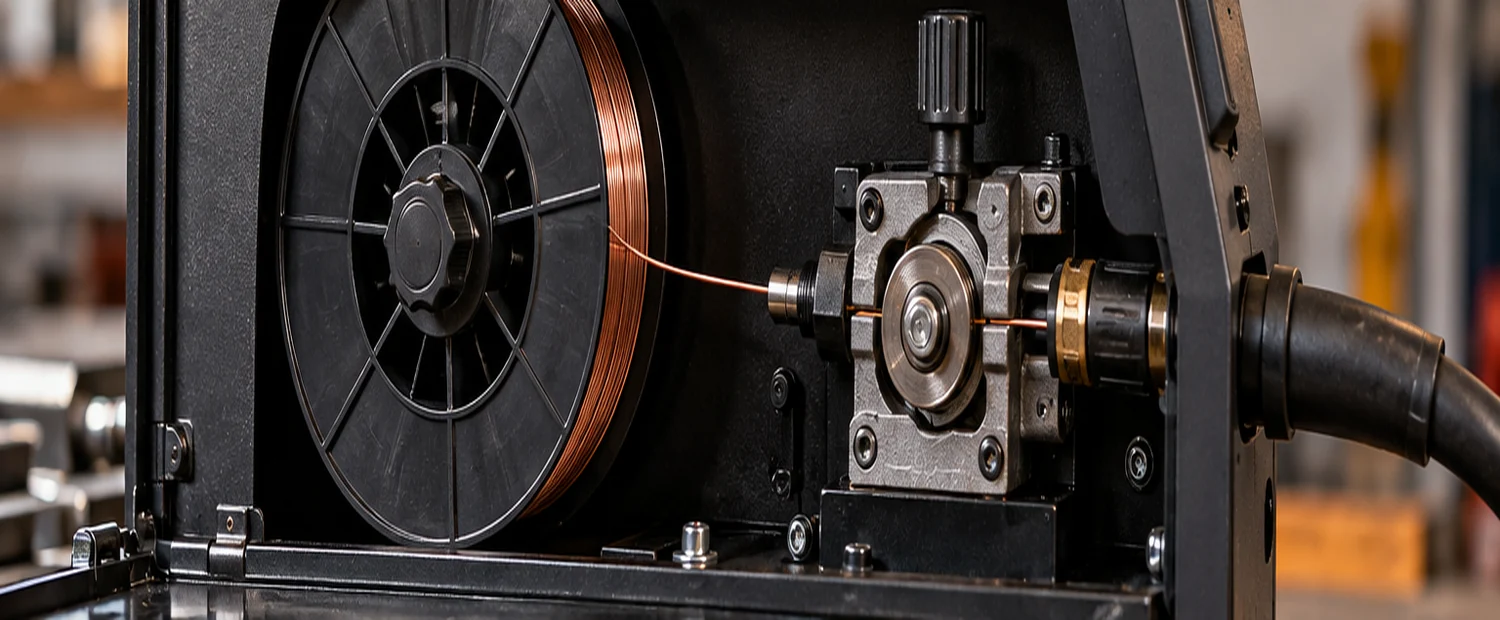
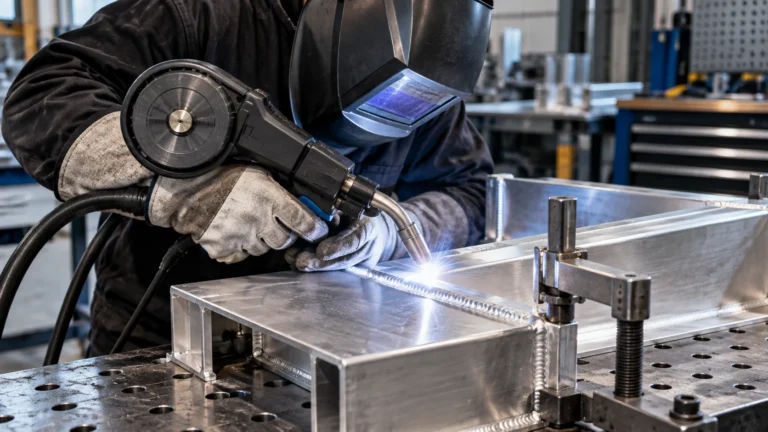
The wire-feed path pictured here is illustrative, not a depiction of any listed model. With the machine unplugged and following its manual, verify that the roll, liner and contact tip suit the selected wire diameter. New welders often blame inconsistent feeding on their technique when the installed consumables do not match the wire.
4. Read duty cycle at the stated output
A duty-cycle number describes permitted arc-on time during a rated test interval at a specified welding output. It does not mean “this machine runs at full advertised amperage for that percentage.” For example, the Lincoln 90i is rated at 90 A and a 30% duty cycle, not 120 A at that same duty cycle. Allow cooling according to the owner’s instructions and do not obstruct vents.
When none of these is the right first welder
If the job involves load-bearing vehicle repairs, lifting hardware, pressure-containing parts, critical trailer structures or unverified metal/coatings, a beginner machine and internet settings chart are not a substitute for design, qualification and inspection. Pause the project and use a properly qualified welding professional. The same applies if your space cannot be made fire-safe, lacks adequate fume controls or has an electrical supply you cannot verify.
Aluminum as your first priority changes the decision as well. Confirm that the precise machine, gun/feeding system, gas and wire combination is manufacturer-approved for the material before buying. An advertised “MIG” label alone does not establish aluminum compatibility.
A safe first practice session is deliberately small
Start with clean scrap mild steel of known composition and a stable clamped joint, in a prepared hot-work space. Follow the exact welder manual for polarity, wire loading, gas setup and starting settings. Keep observers protected from arc radiation. Use suitable welding PPE and local fume controls based on the material and exposure. Move combustible materials out of the hazard area and have appropriate fire protection ready. Treat every just-welded part as hot.
Stop before striking an arc if the circuit trips repeatedly, cables or plugs are damaged, the work area contains unknown coatings, the fume-control plan is inadequate or the gas cylinder is not properly secured. Do not open the energized machine to troubleshoot it. Manufacturer instructions and relevant workplace hot-work rules take priority over quick online tips.
Frequently Asked Questions
Can a beginner learn MIG without a shielding-gas bottle?
Yes, with a welder that supports self-shielded flux-core wire, but that is FCAW rather than solid-wire gas MIG. The Forney 261 supports flux-core only, while the Lincoln 90i and YESWELDER listed here support both processes. Gasless welding still produces fumes and needs suitable ventilation and PPE.
Will a 120-volt MIG welder work on any garage outlet?
No. Voltage alone does not establish adequate circuit capacity. Check the manufacturer’s required input current, branch protection and plug details against your actual electrical supply. If the garage circuit is shared, modified or uncertain, consult a qualified electrician rather than bypassing breakers or guessing.
Should I choose a multiprocess welder as my first machine?
Only if you expect to use its extra processes or dual-voltage flexibility. For straightforward mild-steel MIG practice, the Lincoln 90i offers a smaller first learning problem. The YESWELDER 205DS PRO makes more sense if you can support its electrical requirements and intend to explore stick or lift TIG later.
Can one of these beginner MIG machines weld aluminum?
Do not assume so. Aluminum requires an exact manufacturer-approved combination of machine settings, suitable wire feeding or spool gun, shielding gas and filler. The Forney 261 is flux-core-only and is not suitable for aluminum. Check the exact manual and accessory list before selecting either MIG-capable alternative for that material.
The buying decision: choose the Lincoln 90i for a focused first gas-MIG setup, the YESWELDER for credible future process expansion, or the Forney 261 only when self-shielded flux-core is actually your goal. Check electrical supply and safety controls before any of them goes into the cart.