
GearAndSteel is reader-supported. As an Amazon Associate I earn from qualifying purchases. When you buy through links on our site, we may earn an affiliate commission, at no extra cost to you. Learn more.
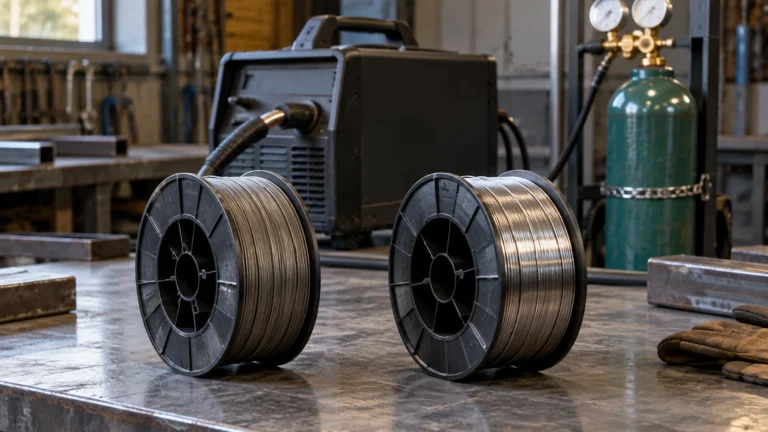
Choose welding wire by process, base metal, shielding method, and machine compatibility, in that order. For routine mild-steel MIG welding with a gas cylinder, ER70S-6 solid wire is a practical starting point. For a compatible machine working outdoors without shielding gas, self-shielded flux-core wire may be more suitable. Diameter and spool size matter, but neither can make the wrong wire classification work.
Which welding wire do you actually need?
The spool aisle combines several different welding processes. A machine labeled “MIG/flux-core” may be able to feed solid gas-shielded wire and certain self-shielded wires, but the setup is different. Make these choices before comparing brands.
| Job and setup | Typical wire family | External gas? | First thing to verify |
|---|---|---|---|
| Indoor carbon-steel fabrication with gas-capable MIG machine | ER70S-6 solid steel wire | Yes | Shielding gas, output range and approved diameter |
| Outdoor carbon-steel repair with a compatible self-shielded feeder | Specified self-shielded flux-cored wire, such as E71T-11 or E71T-GS | No for a genuine self-shielded classification | Exact classification, polarity and single-pass versus multipass limits |
| Production flux-cored work using a gas supply | Gas-shielded FCAW wire to the applicable procedure | Yes | Wire classification, gas, polarity and procedure |
| Stainless steel work | Compatible stainless filler classification | Usually yes for solid-wire GMAW | Base alloy, service requirements and shielding gas |
| Aluminum MIG welding | Selected aluminum alloy wire | Yes | Alloy match and aluminum-capable wire delivery system |
Fast default: If you have clean mild steel, a properly equipped MIG machine and shielding gas, start your search with ER70S-6 in a manufacturer-approved diameter. If you have a small flux-core-only machine, check its manual for the specific self-shielded classification. Do not assume all flux-cored wires are gasless.
What is welding wire, and what does it do?
In GMAW (commonly called MIG welding), a powered feeder pushes a continuous wire electrode through the gun. The wire carries welding current and becomes filler metal in the joint. Solid wire depends on an external shielding gas. Flux-cored arc welding (FCAW) uses a tubular wire filled with flux ingredients; some types also require external gas.
There are other consumables that people casually call welding wire. TIG (GTAW) usually adds a separate filler rod by hand rather than feeding a continuous electrode through a MIG gun. Stick welding uses coated electrodes, not a continuous spool. A product described as “TIG welding wire” is not necessarily suitable for a MIG feeder.
On the spool label, the AWS classification matters more than a generic “welding wire” description. It identifies a wire family with defined requirements; it does not by itself certify that the weld you make will satisfy a structural code or a particular repair specification.
Solid MIG wire vs. flux-core: the decision that changes the setup
Solid MIG wire: cleaner shop work with shielding gas
ER70S-6 is a common carbon-steel GMAW filler. Its manganese and silicon deoxidizers give it more tolerance of some mill scale than lower-deoxidizer alternatives, but this is not permission to weld over paint, oil, heavy rust or unknown coatings. Prepare the joint and follow the procedure. Solid wire generally avoids the flux slag that FCAW creates, which can reduce cleanup on visible shop joints.
Forney identifies its ER70S-6 item 42291 as .030-inch solid wire on a 2-pound spool, intended for mild-steel MIG applications with argon/CO2 shielding gas and DCEP polarity. It is a concrete example for an occasional home-shop user with a gas-capable machine. It is the wrong purchase for a machine designed to run only gasless flux core.
Forney 42291 ER70S-6, .030-inch, 2-pound spool
For carbon-steel MIG work when you already have the required shielding gas and your feeder accepts the spool and wire diameter.
Why consider it: Forney documents its classification, diameter, DCEP polarity and gas requirement. The 2-pound package is worth considering for occasional use, but physically confirm your welder’s spindle and spool requirements. Skip it if you need self-shielded operation, a different base-metal filler or a wire size outside your machine’s approved range.
Self-shielded flux-core: an option without the gas cylinder
A self-shielded FCAW wire protects the weld by products of the flux core rather than a separate shielding-gas cylinder. That can simplify outdoor work where wind could disturb the shielding on a conventional solid-wire MIG setup. It is not a universal cure for poor surface preparation, and FCAW often creates more visible fume, spatter or slag to control and remove.
The classification is decisive. An E71T-GS wire is commonly associated with single-pass applications, while some E71T-11 products are approved for multipass applications. The exact maker’s data sheet and welding procedure control; do not extrapolate an E71T-11 recommendation to an E71T-GS spool.
Forney’s item 42300 is specifically a .030-inch, 2-pound E71T-GS self-shielded carbon-steel wire. The manufacturer specifies no external shielding gas, DCEN polarity and its suitability for single-pass work. That is a useful alternative to the gas-shielded product above, not a drop-in substitute in the same machine settings.
Forney 42300 E71T-GS, .030-inch, 2-pound spool
For suitable carbon-steel repair work when your machine supports this wire classification and its specified polarity.
Why consider it: The official product page establishes the E71T-GS classification, DCEN polarity, 2-pound package and no-gas operating requirement. Skip it for applications demanding a different wire classification, qualified multipass procedure, stainless/aluminum filler or a machine that cannot support the specified setup.
Do not confuse gas-shielded and self-shielded FCAW. Gas-shielded flux-cored wires need a cylinder even though the wire contains flux. Also, polarity is a wire-specific requirement, not a safe blanket rule for everything labeled “flux core.” Follow the exact wire manufacturer’s instructions and your welder’s manual, with the power disconnected for permitted setup changes.
Welding wire sizes: .023, .030, .035 and .045 inch
Wire diameter changes how a given machine can feed and melt the electrode. It is not a standalone plate-thickness rating. Miller’s mild-steel guide calls .030-inch solid wire a versatile general-purpose size, notes .023-inch for thinner work where lower heat input matters, and identifies .035-inch and larger wires for applications with greater output demands. Those are selection directions, not permission to ignore the machine’s chart.
| Common nominal diameter | Why a buyer might consider it | What can disqualify it |
|---|---|---|
| .023 to .024 in | Thin-gauge steel using compatible solid-wire GMAW equipment | Machine, tip or feeder cannot support it; insufficient capacity for the target weld |
| .030 in | Flexible entry point for many light-to-medium carbon-steel MIG jobs | Wrong class or incorrect setup; machine cannot feed or melt it for the planned joint |
| .035 in | Higher-output work where the particular wire and machine support it | Drive-roll, contact-tip or output limits; incorrect assumption that bigger is always stronger |
| .045 in | Higher-deposition setups with an adequately rated machine and procedure | Many compact welders cannot feed or operate it correctly |
Two spools marked “.030” can demand completely different gas, polarity and joint procedures. Likewise, a .035-inch spool cannot fix insufficient power or lack of fusion. Use the equipment’s wire-specific settings chart and the filler manufacturer’s application limits; qualified work may additionally require a welding procedure specification (WPS).
Check spool fit and feed components before ordering
Many disappointed buyers selected the correct alloy and wire diameter but overlooked the physical package. A 2-pound spool and a 10-pound spool may have different outside diameters, bore designs or hub requirements. A wire feeder’s stated weight capacity alone is not enough to guarantee that any brand’s spool fits.
- Read the welder manual: Check accepted process, wire classification or type, diameter range, spool size and required spindle adapters.
- Match the feeding path: Verify the drive-roll groove, contact tip and gun liner suitability for the wire type and diameter. Some tubular wires require different drive-roll profiles than solid steel wire; do not assume your present rolls are correct.
- Confirm polarity and shielding: Check the exact wire data sheet and the welder’s permitted configuration, including any gas requirements. Never switch polarity on an energized machine or modify wiring beyond manufacturer instructions.
- Consider consumption: A smaller spool can limit leftover wire for infrequent work. A larger spool is only useful if it fits and can be stored clean and dry.
A quick example: an occasional user with a gas-capable compact MIG wants to replace a small .030-inch ER70S-6 spool. Buying a cheaper 10-pound ER70S-6 package is still a mistake if the spindle cannot accept it. Conversely, a correctly sized E71T-GS spool is not a correct replacement until the machine is approved for that process and wire class.
Steel, stainless steel and aluminum are not interchangeable
ER70S-6 is a common starting point for mild carbon steel, not an all-metal filler. Stainless steel selection depends on the base alloy, joint service conditions and the applicable welding procedure; a filler marketed simply as “stainless MIG wire” may not be enough to choose correctly. Aluminum MIG welding requires a suitable aluminum wire alloy, the correct shielding arrangement and a feed system designed to handle soft aluminum wire reliably.
Do not select a filler solely because two base metals look similar or because a seller lists a broad “all purpose” claim. Unknown alloys, pressure-containing components, vehicle structures and load-bearing repairs call for the applicable procedure and qualified assessment. Where filler classification is specified in a drawing, code or WPS, that requirement overrides a generic buying guide.
What to check before the first weld
Wire choice cannot make an unsafe setup safe. Read the welder manual, wire data sheet and safety data sheet. Inspect the equipment with power isolated as instructed; replace visibly damaged cables, tips or liners according to the maker’s guidance, and use proper work clamping. Select arc-rated face and eye protection, flame-resistant coverage, suitable gloves and screening for bystanders.
Fume control is not optional. NIOSH identifies welding fumes as a mixture whose hazards depend on the wire, flux, base metal and coatings. Use appropriate local exhaust and a workplace-specific exposure assessment where required; a random fan or an open garage door is not evidence of adequate protection. Stop and assess the hazard before welding galvanized, painted, lead-bearing, stainless or unidentified coated material. A respirator, where required, belongs within a suitable respiratory-protection program, not as a substitute for engineering controls.
Keep combustibles and gas cylinders away from sparks and hot metal in accordance with applicable hot-work controls. For a new wire, verify all machine and consumable settings on the approved chart and make practice welds on representative scrap before attempting a noncritical project. For structural or safety-critical joints, follow a qualified procedure rather than a trial-and-error settings table.
The five-label buying check
Before adding wire to your cart, record five things from the package and your machine documentation: (1) classification, (2) base-metal application, (3) diameter, (4) external-gas and polarity requirements, and (5) spool format. If any one is unresolved, do not order by photo or price alone. For a gas-equipped carbon-steel MIG setup, the reviewed Forney 42291 is an example of a solid-wire choice; for a compatible gasless setup and suitable single-pass work, Forney 42300 illustrates the different self-shielded path.
More specific decisions, including comparing flux-core wire classifications and choosing the best spool for a particular job, belong in their own focused guides. This page is the starting map, not a substitute for your machine’s instructions or a qualified welding procedure.
Frequently Asked Questions
Is welding wire made of copper?
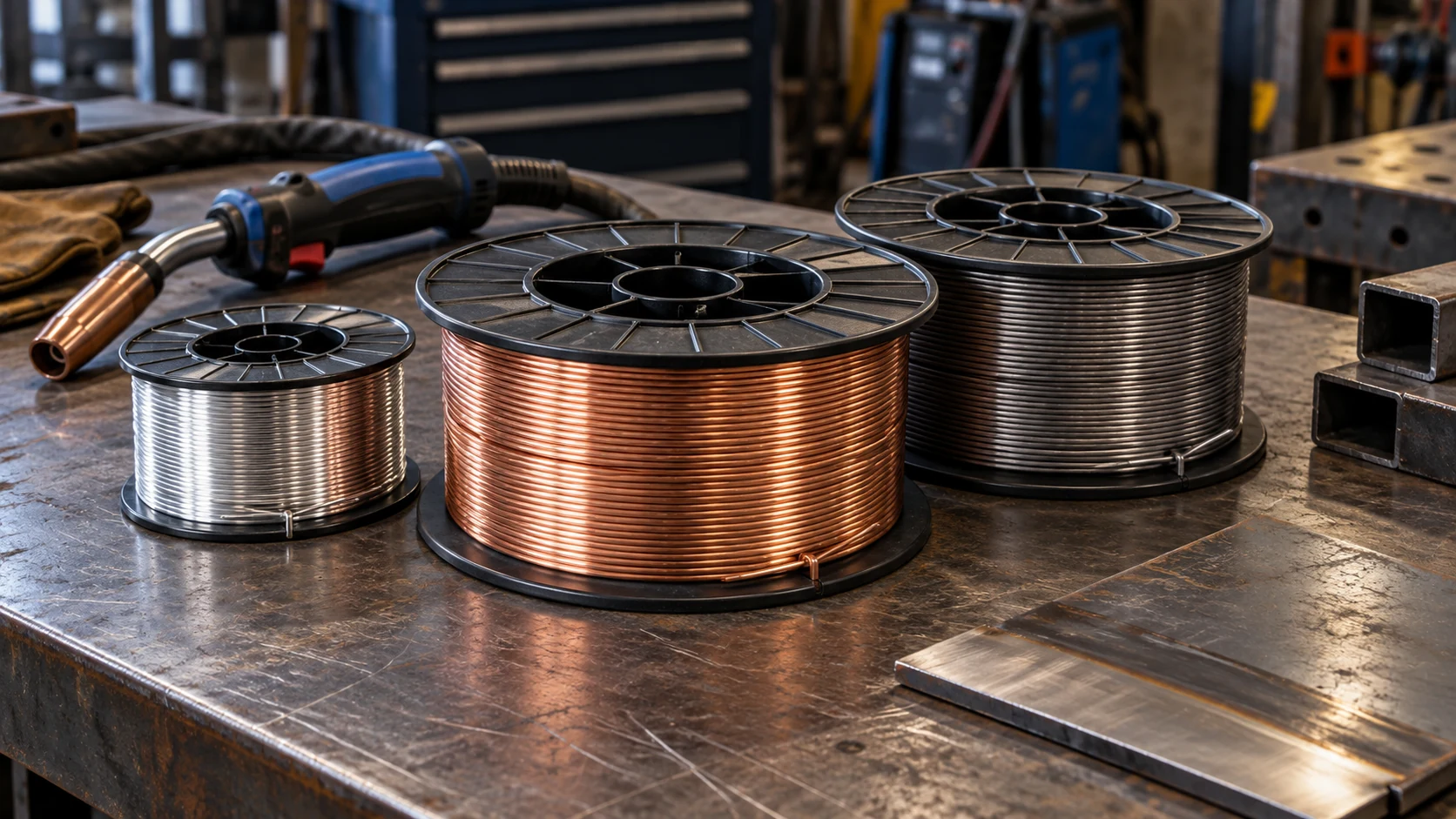
Common mild-steel solid MIG wire is steel wire with a thin copper coating, not solid copper. Other fillers use different alloys or coatings. Check the AWS classification and base-metal compatibility instead of judging the wire by its color.
Does welding wire go bad in storage?
Wire can become unusable if it rusts, picks up moisture or contamination, or develops feeding damage. Store it clean and dry according to its maker’s directions. Do not assume a visibly corroded spool is suitable for a critical weld.
Can I run flux-core wire in any MIG welder?
No. The machine must support the particular wire class and diameter, the correct feed parts, and the maker-specified polarity. Self-shielded and gas-shielded flux-cored wires have different requirements, so the word “flux” on the packaging is not sufficient.
Is .030-inch or .035-inch welding wire better?
Neither is inherently better. .030-inch is a common general-purpose starting point on compatible home-shop machines; .035-inch may suit higher-output applications. The joint, process, welder output and wire data sheet determine the correct choice.