

GearAndSteel is reader-supported. As an Amazon Associate I earn from qualifying purchases. When you buy through links on our site, we may earn an affiliate commission, at no extra cost to you. Learn more.
A good welding table is a stable, noncombustible steel work surface that holds parts securely while you fit, tack, and weld them. For a first dedicated shop table, start by measuring your largest typical assembly, then check top rigidity, usable clamping access, and the actual hole system. A small fixed table can be more useful than a larger folding one if it keeps your work square.
Choose the table around the work, not the advertised capacity
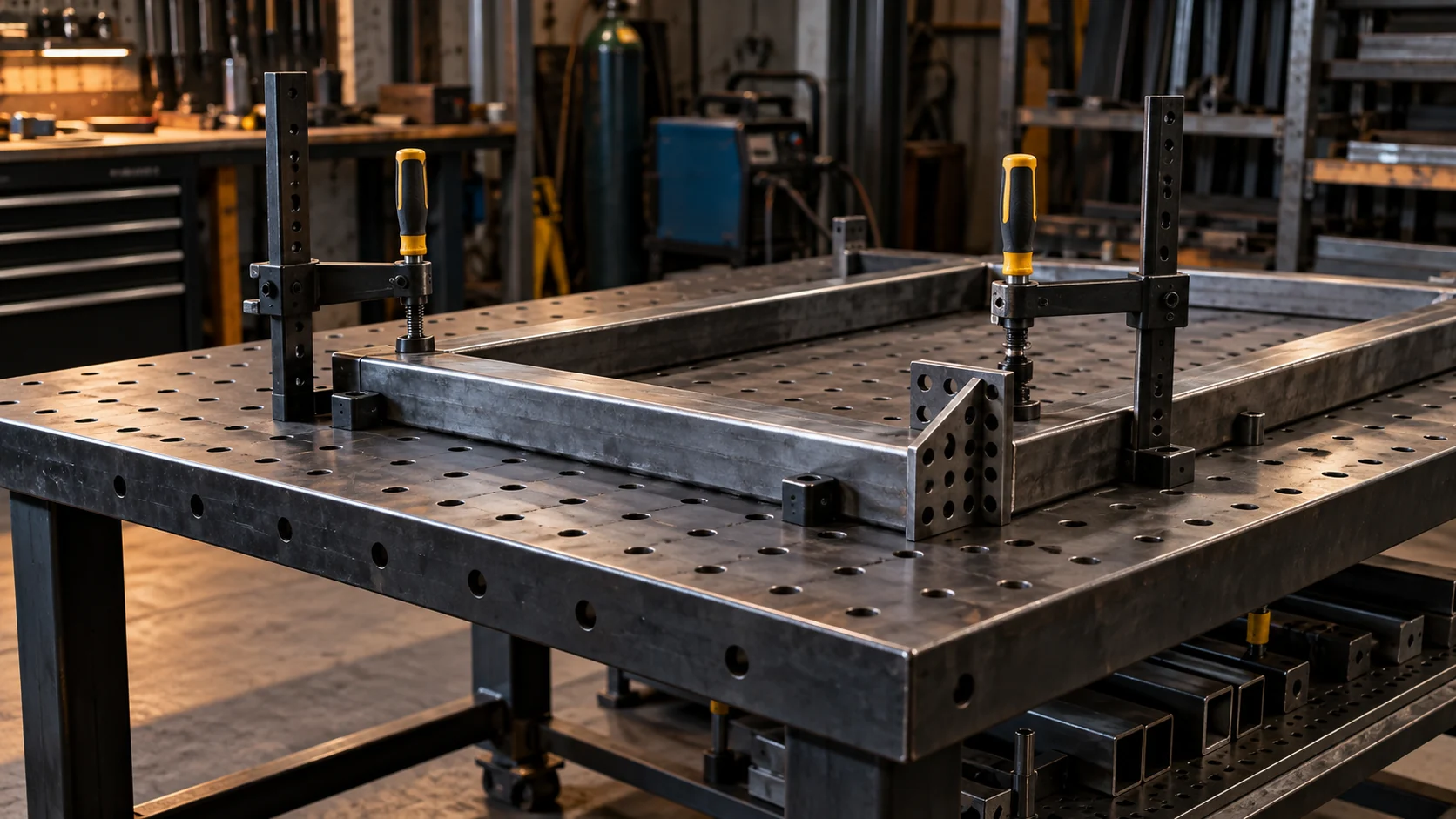
A welding table does two jobs: it supports the metal and gives you a dependable reference for positioning it. The second job is easy to miss. A frame can fit on a tabletop and still be frustrating to build there if clamps cannot reach the inside corners or the frame hangs far beyond an unsupported edge.
| Your usual work | Table to consider | Check before buying |
|---|---|---|
| Small brackets, practice coupons, occasional repairs | Compact steel top or portable bench | Secure footing, convenient work height, reachable clamp slots |
| Gates, furniture frames, repeatable square assemblies | Fixed fixture table with a defined hole grid | Matching pins, stops, clamp reach and access below the holes |
| Shared garage or changing work locations | Folding or wheeled table | Positive locks, caster brakes, stability while loaded, storage footprint |
| Large repeat production or tight dimensional tolerances | Purpose-built modular fixturing system | Published flatness specification, tooling ecosystem, floor support, installed cost |
The practical starting point: For many hobby fabrication tasks, a roughly 36-by-24-inch steel top is worth considering, but it is not a universal standard. It gives room for a small frame and clamps while leaving some garage floor space. If your common projects are long rails or large frames, measure the assembly and the clamp positions first. An impressive load rating does not make a short table any longer.
Six checks that prevent a bad welding table purchase
1. Usable surface area and edge access
Measure the workpiece after accounting for fixture blocks, clamps, and room to reach the joint. A 36-by-18-inch top may accept the same nominal weight as a 36-by-24-inch top yet give you six fewer inches of depth for squaring a rectangular frame. An open edge can be valuable because a regular C-clamp may work there even when no proprietary fixture kit is available.
2. Top material, thickness, and support structure
Plain steel is the conventional all-around welding-table material: it is noncombustible and can accept common magnetic layout aids where appropriate. But thicker is not automatically flatter. Plate thickness, the frame underneath, how the top is attached, heat input, and the manufacturer’s flatness tolerance all matter. A thin top adequately supported for occasional small work is a different product from a precision fixturing plate intended for repeatable setups.
Be careful with tables sold as stainless-steel, aluminum, or galvanized work surfaces. Their material, coating, contamination behavior, and application need to suit the work. Avoid welding on or heating coatings whose hazards have not been assessed, and do not assume any coating removes the need for local fume control. For clean material-specific work, seek a manufacturer-documented surface and handling procedure rather than improvising.
3. Hole diameter, spacing, and the actual clamp system
This can matter more than top thickness. A table described as having 5/8-inch holes is not automatically compatible with every tool advertised for a 16 mm system. Those nominal dimensions are close but not identical, and pin fit also depends on tolerance, edge chamfer, hole depth, and the tool maker’s specification. A table with 0.7-inch holes is a different fit again. A grid of useful-looking holes can become expensive decoration if the pins and stops you own do not seat properly.
Compare the table and tool as a system: hole diameter, center-to-center spacing, accessible underside, material thickness, clamping method, and documented part numbers. Strong Hand Tools, for example, publishes distinct metric and imperial systems rather than treating all grids as interchangeable. Do not drill out an unknown table or force a retaining pin to make accessories fit.
4. Static load rating versus working stability
Manufacturers and sellers often quote a maximum load, sometimes explicitly a static capacity. That is not permission to lever a long frame off the edge, stand on the table, apply shock loads, or weld while a wheeled base can move. Check the rated loading conditions, total weight of parts plus fixtures, center of gravity, leg spread, and whether the work can tip the table. Unclear rating basis is a reason to ask for the manual before purchase.
5. Height, mobility, and lock points
Welding at an awkward height encourages poor positioning. Consider how you will clamp, inspect, tack and finish the joint, not just where the table will store. Folding mechanisms, tilt hinges, casters and height pins introduce more places where a loose latch or unlevel floor can cause movement. Verify all required locks and leveling features in the specific model’s instructions, then check stability again after moving the table.
6. What is actually included
Some tables include clamps, backers and stops, while others are only a steel top and stand. Compare what is required for your first real task, not accessory counts. Four correctly sized clamps and a usable square stop can be worth more than a large assortment that does not match the holes. Budget separately for work holding and measurement tools if the package does not include them.
Four real table configurations to compare
These are reference options for different shop needs, not hands-on test winners. Specifications below are from the identified manufacturer pages or, where stated, the corresponding Amazon listing. Verify the exact listing variant, manual and shipping conditions before ordering. A fixed shop table, a compact wheeled table and a folding workstation solve different problems.
| Identified model | Surface / configuration | Buyer fit | Critical limitation | Amazon |
|---|---|---|---|---|
| Eastwood 36 x 24 Fixturing Table | 36 x 24 in.; fixed or low benchtop; 5/8-in. holes on 2-in. centers | First repeatable fixture setups | Occupies a dedicated footprint | View model |
| VEVOR 36 x 24 fixed table | 36 x 24 in.; fixed legs; advertised 0.63-in. holes | Simple steel workstation | Check tooling fit and as-delivered flatness | View model |
| KASTFORCE KF3002 | 36 x 18 in.; wheeled cart-style bench; listed 5/8-in. holes | Shallow bench with convenient mobility | Less front-to-back fixture space | View model |
| Goplus 42 x 21 folding table | 42 x 21 in.; folding/height-adjustable; listed 0.7-in. holes | Shared garage and stow-away work | Hole size is not nominal 5/8-in. tooling | View model |
Eastwood 36 x 24: an accessible fixture kit for a stationary shop
Eastwood’s published specification identifies a 36-by-24-inch, 6-gauge steel tabletop, a 600-pound rated capacity, 5/8-inch holes on 2-inch centers, and a reinforced frame. The table can be set up with full-length legs or used at low benchtop height. Its published kit includes clamps, stops, V-blocks and leveling feet. That makes it a sensible reference if your first projects involve square tube frames and you want to start fixturing immediately.
Skip it when you cannot spare the floor space, need a larger plate, or require documented precision-table tolerances beyond the published starter-table specification. Its supplied accessories do not turn it into a production-grade metrology surface.
Check the Eastwood table on Amazon
VEVOR 36 x 24: fixed footprint without assuming a full fixture ecosystem
VEVOR lists the fixed 36-by-24-inch model with 0.63-inch (16 mm) fixture holes, non-slip foot pads and an 800-pound capacity. Its manufacturer page identifies a steel construction and the fixed configuration. This is a candidate when you want a straightforward welding surface and can buy workholding tools according to the table’s real hole specification.
Skip it if you need to fold the table away or expect your existing 5/8-inch pins to fit without a tool-by-tool compatibility check. The hole diameter alone does not certify an entire fixturing system, and the published weight rating says little about precision flatness.
Check the VEVOR fixed table on Amazon
KASTFORCE KF3002: a narrower work cart for smaller layouts
The KF3002 Amazon listing identifies a 36-by-18-inch top, 5/8-inch holes and a 10-gauge top, with a seller-stated 1,200-pound capacity. This format could suit narrow steel assemblies where rolling a compact work surface into place is more useful than having a deeper plate. It is an alternative configuration, not a capacity recommendation based on testing.
Skip it for broad square frames that need front-to-back clamp clearance or when you require a manufacturer-published surface flatness tolerance. Treat the marketplace’s capacity and thermal claims as seller specifications that need manual confirmation for demanding loads, not as independently validated limits.
Check the KF3002 listing on Amazon
Goplus 42 x 21: storage first, precision fixturing second
Goplus documents a 42-by-21-inch galvanized-metal tabletop, folding legs, seven height positions and two included bar clamps. Its official product description identifies approximately 0.7-inch tool holes and slots. The appeal is straightforward: the table can be stored after occasional fabrication, rather than occupying permanent floor space.
Skip it if you already own a standardized 5/8-inch fixture kit or will frequently assemble heavy, repeatable frames that need a rigid stationary reference. The folding base and nonmatching hole diameter are real compromises to consider before deciding that the longer surface is automatically better.
Buy the fixturing system before you buy the hole pattern
Imagine making two identical 24-inch-square tube frames. The expensive part of the second frame may not be welding it. It may be placing all four tubes squarely again while keeping the diagonals consistent. On a table with compatible stops and clamps, you can define the outside corner, support the tubing and repeat the setup. On an ordinary solid plate you can still do accurate work, but the repeatability depends more on a separately built jig and careful measurement.
A sensible first fixture kit has only a few jobs: locate the metal against a reference, hold it without sliding or twisting, and leave access to the weld. Extra clamps cannot fix an uneven surface, and a corner magnet is no substitute for dependable mechanical holding when distortion or heat could shift the assembly.
- For round tube: check whether the supplied V-blocks support the diameter and leave space for a weld.
- For square frames: prioritize verified right-angle stops and clamps that reach both pieces, then confirm the diagonals before tacking.
- For repeat jobs: use the same reference points and a documented clamping order; verify the fit after tack welding because heat can still move metal.
- For mixed-size steel: prefer a versatile mechanical clamp over pins or magnets that only work in one geometry.
Small compatibility test: Before ordering accessories, match the table’s exact hole size and spacing to the accessory part numbers in writing. Test the full combination before starting critical work. Being able to drop a nominal pin through a hole is not proof it will lock or resist lateral movement.
Set up the table so it stays useful and safe
Start with the manufacturer’s assembly and load instructions. Level the feet or secure the specified caster brakes; confirm locking pins and the working surface cannot rock before adding heavy material. Keep the path around the table clear and arrange work so stock cannot fall when a clamp is loosened. A table is not a personnel platform or a substitute for approved lifting supports.
Do not use the table’s metal frame as an assumed welding return path. OSHA 29 CFR 1910.254 requires the welding work lead to be firmly attached to the work and addresses when fixtures or structures form part of the return circuit. Follow your welding machine’s manual, make a clean reliable work-lead connection near the operation whenever practicable, and do not route welding current through casters, bearings, hinges, lifting equipment or unintended fixtures. Welding-current return and protective electrical grounding are not interchangeable concepts.
Remove or protect combustibles and inspect the surrounding work area before hot work. Sparks and heat can pass through holes or ignite material below the tabletop. Keep suitable fire protection available, control fumes at the source, and use the welding helmet, protective clothing, gloves and other protection required for the process and material. OSHA 29 CFR 1910.252 covers workplace welding fire, personal protection and ventilation provisions; applicable site procedures and manufacturer instructions may be more specific.
Stop work if the table moves during setup, the load is not securely supported, any clamp cannot lock as intended, cables are damaged, the return connection is unreliable, nearby flammables cannot be controlled, or the work involves unidentified coatings without an evaluated fume-control procedure. Re-establish safe conditions before welding.
Where your next dollar should go
For occasional repairs, start with a stable steel table and a pair of clamps that actually reach the work. For repeated square frames, prioritize a compatible locating and clamping kit over an inch or two of extra tabletop. For a one-car garage, a folding table may be the only one that gets used, but its locking features deserve close attention. If work routinely exceeds the available surface or needs precise repeatability, stop upgrading a light-duty bench and compare dedicated modular fixturing systems with published tolerances.
Keep related purchases separate: a welding cart carries the machine and its accessories, while a welding positioner rotates a workpiece for access. Neither automatically replaces a stable fabrication table. Those decisions deserve their own equipment comparison rather than another generic tabletop roundup.
Frequently Asked Questions
What is a welding table used for?
A welding table provides a durable working surface for supporting, aligning and securing metal during fitting, tack welding, finishing and assembly. A fixturing table adds holes, slots or dedicated stops that make workholding more repeatable. It does not stand in for a proper work-lead connection, adequate ventilation or safe support for oversized material.
How thick should a welding table top be?
There is no single correct plate thickness. A lightly loaded, well-supported hobby top and a precision modular fixture table are designed for different jobs. Check the manufacturer’s plate specification, bracing, load basis and published flatness tolerance together. If distortion-sensitive repeat work matters, choose a documented system rather than relying on steel gauge alone.
Are 16 mm and 5/8-inch welding table clamps interchangeable?
Not automatically. The nominal sizes are close, but real fit depends on the hole tolerance, locking-pin mechanism, chamfer, plate thickness and hole-grid spacing. Some makers offer separate metric and imperial tooling families. Match exact table and accessory part numbers before you purchase; do not force a clamp that binds or fails to lock.
Can I connect my welder’s work lead directly to a steel welding table?
No. A steel top does not establish a reliable electrical return by itself. Follow the welder manufacturer’s work-lead instructions and secure the lead to the work or an approved connection point for the specific equipment. Do not rely on unknown contact through paint, fixtures, bearings, wheels or hinges to carry welding current.