
GearAndSteel is reader-supported. As an Amazon Associate I earn from qualifying purchases. When you buy through links on our site, we may earn an affiliate commission, at no extra cost to you. Learn more.
MIG welding joins metal with an electric arc and a continuously fed wire electrode. In the process properly called gas metal arc welding (GMAW), shielding gas protects the molten weld from surrounding air. It is a practical starting point for shop fabrication and many steel repairs, but the right machine, wire, gas, electrical supply, and ventilation depend on what you plan to weld.
What is MIG welding?
MIG stands for metal inert gas, although the familiar name is a little misleading. The formal name, gas metal arc welding (GMAW), covers setups using inert or active shielding gases. For example, a widely used gas blend for ordinary mild-steel GMAW contains argon and carbon dioxide, so the process is not always literally shielded by an inert gas.
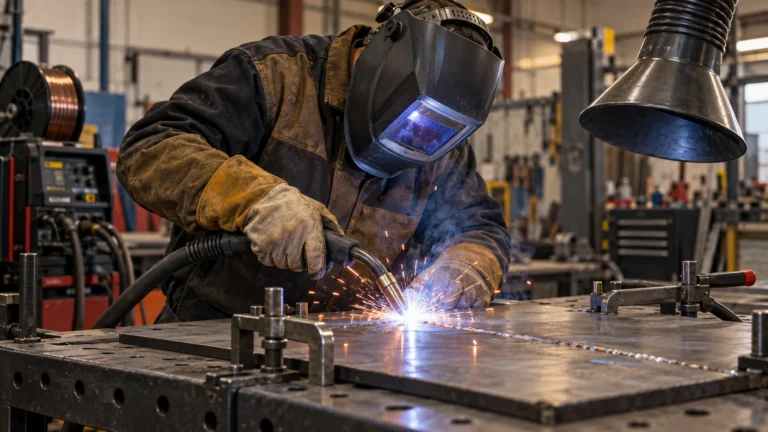
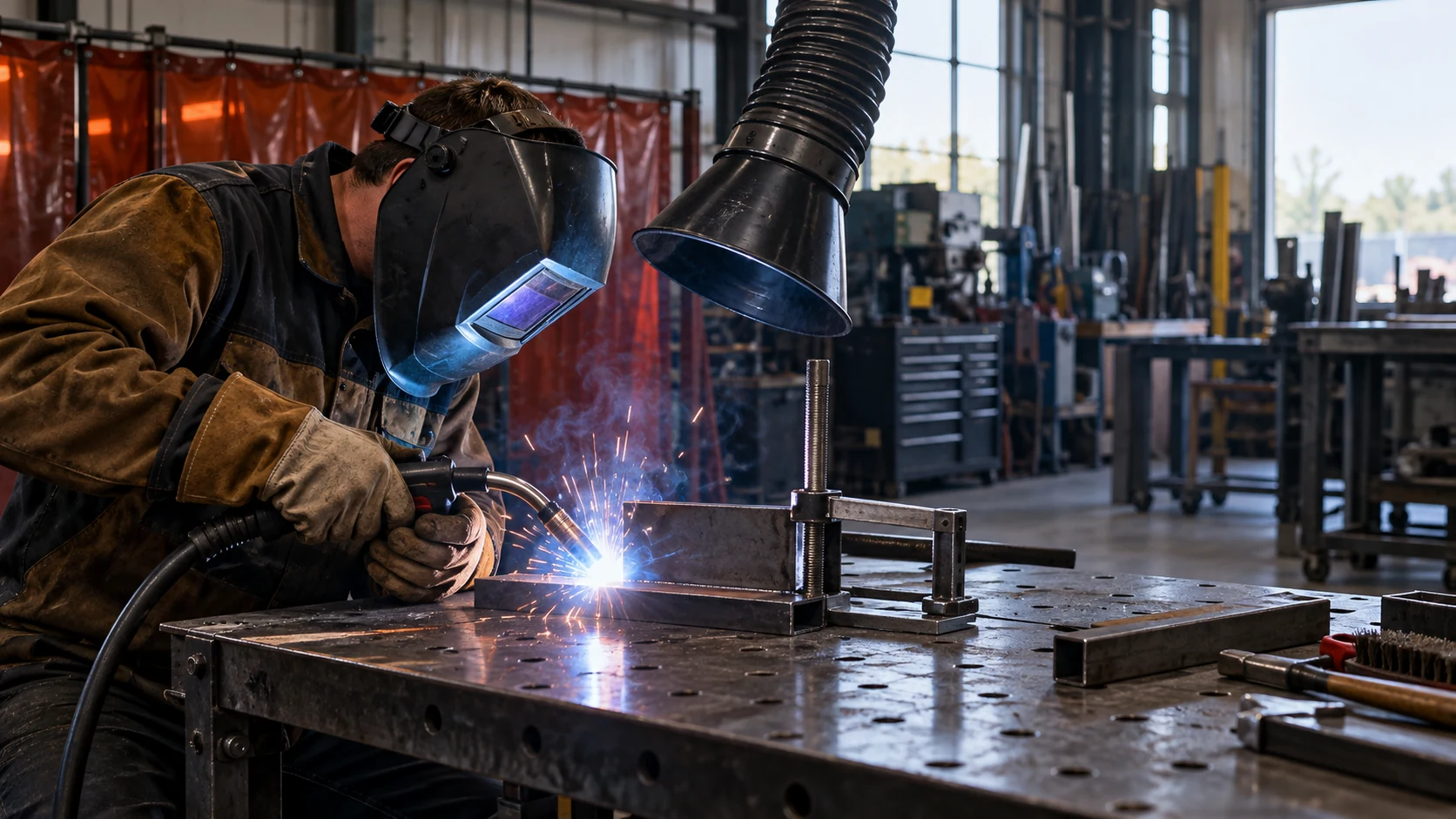
The consumable wire serves two jobs: it carries current to the arc and becomes filler metal in the joint. A wire feeder drives it through the gun; the arc melts the wire tip and a small area of the base metal. Shielding gas exits the gun nozzle around the arc to limit contamination from the atmosphere. Once the molten pool solidifies, it forms the weld.
Because the machine feeds wire continuously, the operator does not repeatedly stop to replace a short stick electrode. That makes MIG attractive for routine fabrication, automotive sheet-metal work, and learning controlled torch movement. It does not mean the resulting weld is automatically sound: preparation, joint design, travel technique, process settings, and inspection still matter.
How a MIG welding system works
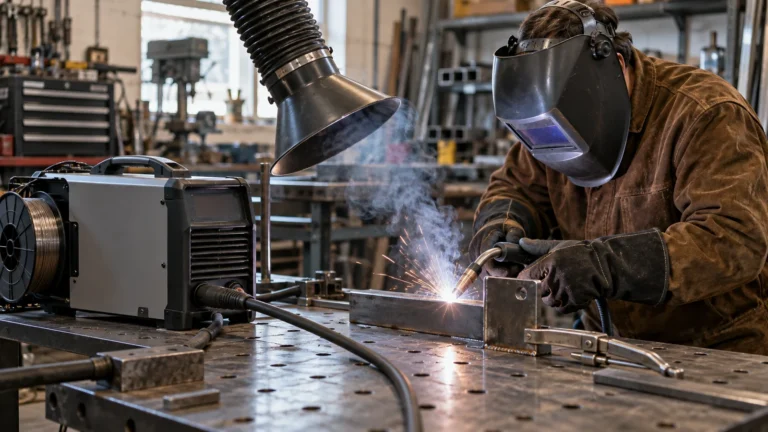
Think of MIG as a coordinated system rather than just a box with two knobs. A typical constant-voltage power source works with a wire feeder and gun; the electrical return path runs through the work cable and its work clamp. Gas-shielded GMAW also needs an appropriate gas supply, regulator or flow control, and hose. These parts must be compatible with the particular machine and filler wire.
| Part | What it does | What to check before buying |
|---|---|---|
| Power source | Supplies controllable welding power | Input circuit requirements, rated output, duty cycle at a specified current |
| Wire feeder and spool | Moves filler wire toward the arc | Supported wire diameter, spool size, feed-roll type |
| MIG gun, liner, contact tip | Guides wire and transfers current near the arc | Gun connection and wire-size-specific consumable fit |
| Gas system | Delivers shielding gas to the nozzle | Gas type, compatible regulator, hose and safe cylinder storage |
| Work cable and clamp | Completes the welding-current return path | Sound connection to suitable clean metal; equipment condition |
| PPE and fume controls | Protect against radiation, heat, sparks and airborne contaminants | Task-appropriate protection and effective ventilation |
One easily missed distinction: the work clamp is not a substitute for the protective equipment grounding required by the manufacturer and electrical code. A poor work connection can disrupt the arc, but improvising household wiring to fix it creates a different, more serious hazard.
MIG vs. flux-core: similar machines, different processes
Many compact machines are marketed as “MIG/flux-core,” which creates confusion. Solid-wire GMAW uses externally supplied shielding gas. Flux-cored arc welding (FCAW) uses tubular wire with a flux-filled core; some FCAW wires are self-shielded, while others still require an external gas supply. Self-shielded FCAW is not simply “MIG without the gas bottle.” It is a distinct process with different wire, application and setup requirements.
| Question | Gas-shielded MIG (GMAW) | Self-shielded flux-core (FCAW-S) |
|---|---|---|
| External shielding cylinder? | Yes | No, when the wire is specifically self-shielded |
| Wind outdoors? | Can disturb shielding; protect the weld zone | Often more practical outdoors, but wire limitations still apply |
| Slag removal? | No flux slag from solid wire | Slag removal is generally required |
| Common starting point | Indoor, clean mild-steel fabrication and sheet metal | Suitable repair or field work with the correct wire and machine |
| Can you swap wire and keep every setting? | No. Confirm polarity, drive rolls, tips, wire classification and machine instructions. | |
This distinction changes the shopping list. A machine advertised as “gasless MIG” may be intended for self-shielded FCAW rather than genuine gas-shielded GMAW. Check for documented gas-solenoid and shielding-gas connections instead of trusting the category label. A gas-capable machine is not automatically compatible with every flux-cored wire.
What metals can you MIG weld?
Mild steel is a sensible first material for learning the process. Common carbon-steel solid wires such as ER70S-6 are used with an appropriate shielding gas; the wire diameter, material thickness and machine output must still be matched. Remove coatings, oil, paint and contaminants rather than assuming deoxidizers make dirty metal safe to weld.
Stainless steel can also be welded using GMAW, but stainless filler selection and shielding gas depend on the alloy and required properties. Welding fumes can contain particularly hazardous constituents, including hexavalent chromium in some circumstances. An ordinary garage fan is not proof that exposure is controlled.
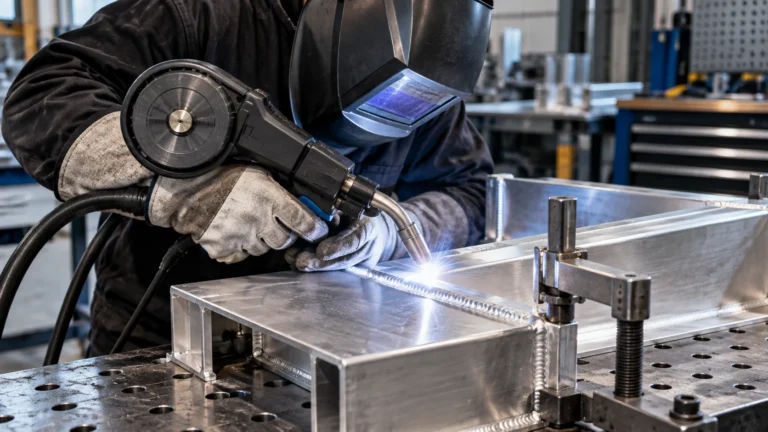
Aluminum requires another level of equipment and technique planning. Feeding soft aluminum wire through a long conventional steel-wire liner can be troublesome; some systems use an appropriate spool gun or push-pull setup. Filler alloy, shielding gas, joint preparation and the manufacturer’s supported configurations must be confirmed before purchasing accessories. This overview is not a substitute for a material-specific procedure.
For load-bearing, pressure-containing, road-safety or other code-governed joints, do not select a process from an introductory chart alone. The relevant procedure, material identification, qualification and inspection requirements govern whether a weld is acceptable.
Where should a beginner start?
Start with the job and the workspace, not a headline amperage number. A machine that looks powerful on a product page may not suit your available branch circuit, required wire size or longest weld. Use this decision path before comparing individual models.
- Identify the work. Write down the base metal, approximate thickness range, joint type, and whether the work is structural or subject to a welding code.
- Choose the process. For indoor mild-steel practice with suitable ventilation, gas-shielded GMAW is often convenient. For wind-exposed field work, investigate compatible self-shielded FCAW rather than trying to weld with blown-away shielding gas.
- Verify electrical supply. Read the exact machine’s input-voltage, receptacle and circuit requirements. A 120 V label alone does not establish that your existing outlet or circuit is suitable. Never bypass protection or improvise adapters.
- Check output and duty cycle. Duty cycle only means something at a stated welding output and the manufacturer’s test conditions. A maximum-current number does not tell you how long the machine can weld at that current.
- Check the complete system. Confirm gas capability, compatible wire and spool sizes, available replacement tips and liners, and the PPE and fume controls the task requires.
A useful no-buy rule: if you cannot identify the electrical requirements, compatible filler wire or safe fume-control arrangement, do not order accessories by appearance and attempt to make them fit later. Resolve those unknowns first.
Consumables and tools worth understanding first
The machine and safety equipment matter most. Once you have an actual gun model and wire diameter, contact tips and liners are recurring wear items; gas nozzles need inspection and cleaning. These parts are not universal. The wrong contact-tip size or incompatible nozzle can cause feeding or shielding trouble that looks like a machine problem.
An inexpensive maintenance accessory can be more broadly reusable than a box of guesswork-specific gun parts. For example, Strong Hand Tools PM12 Deluxe MIG Pliers are a dedicated tool for trimming wire, gripping small gun components and cleaning nozzle spatter. Strong Hand’s own PM12 description documents the file edges, V-notch, two light-duty hammer faces and retaining chain. They are a convenience tool, not a replacement for correct gun consumables or an answer to an electrical fault.
View the Strong Hand PM12 MIG pliers on Amazon
If you already own suitable tools, buy nothing extra for this step. Spend the time checking whether your wire classification, shielding gas and tip size actually match the work and the gun. Always turn off and safely isolate equipment, and let components cool, before gun maintenance as directed by the equipment manual.
MIG welding safety is part of the setup
The arc produces hazardous ultraviolet and infrared radiation, intense light, hot metal and sparks. Welding can also expose workers to metal fumes and gases; the risk depends on the base metal, coatings, consumables, process and space. OSHA’s welding rules address fire prevention, protective clothing, eye protection and ventilation. Appropriate PPE and a welding screen protect the welder and people nearby, but they do not replace fume controls.
- Protect eyes and skin. Use a properly rated welding helmet with the shade required for the operation, safety glasses where appropriate, flame-resistant clothing, suitable welding gloves and protective footwear. Shield bystanders from the arc.
- Control fumes at the source. Assess the material and coatings, use suitable local exhaust or other controls, and follow workplace respiratory-protection rules where respirators are required. Never assume that being outdoors or wearing an ordinary dust mask makes fumes harmless.
- Prevent fire. Clear or shield combustibles, protect openings where sparks can travel, keep appropriate fire equipment ready, and follow any required hot-work authorization and fire-watch procedures.
- Handle gas cylinders correctly. Secure cylinders upright, protect valves, use the correct regulator and connections, and keep cylinders out of unsafe positions or confined-space work areas.
- Respect electricity. Keep equipment dry and intact, inspect cables, and follow the manufacturer’s circuit and grounding instructions. Do not work on energized internals.
Stop before welding if the metal has an unknown coating, ventilation is inadequate, combustible material cannot be controlled, the electrical supply is unsuitable, a cylinder cannot be secured, or the work requires a qualified procedure you do not have. Never weld a used drum, tank or sealed container without the proper specialist controls; residual contents and pressure can cause a fatal incident.
What to learn after the MIG basics
Once the process makes sense, divide the next questions instead of hunting for a universal machine setting. Start by comparing MIG machine classes for your power supply and materials. Next, study the manufacturer’s setup chart for the exact wire, gas and metal thickness. Then learn gun handling, bead evaluation and common defects with qualified instruction or supervised practice on noncritical steel coupons.
Those are separate questions: which MIG welder to buy, which MIG settings to use, and how to MIG weld deserve their own focused guides. The same goes for aluminum and stainless steel. This page is the map, not a ready-made welding procedure for every machine and material.
For occasional MIG gun maintenance, check the PM12 pliers listing on Amazon after confirming you actually need the tool. For all process-critical accessories, match the exact part and wire specification to your machine before ordering.
Frequently Asked Questions
Is MIG welding hard to learn?
Learning to start an arc and lay a bead is relatively approachable because the machine continuously feeds wire. Producing a sound joint is harder: positioning, preparation, material thickness and inspection still matter. Begin with supervised practice on noncritical mild-steel samples rather than safety-critical repairs.
Does MIG welding always require a gas cylinder?
Gas metal arc welding (GMAW) requires external shielding gas. A machine advertised as “gasless MIG” is commonly being used for self-shielded flux-cored arc welding instead. Some flux-cored wires do need shielding gas, so check the wire classification and machine manual before choosing the process.
Can the same MIG welder handle steel and aluminum?
Some machines support both, but a “MIG” label alone does not prove aluminum capability. Confirm output range, gun or spool-gun compatibility, wire feeding equipment, correct filler alloy and shielding-gas requirements for the exact model and application.
Are MIG welds as strong as other welds?
A properly designed and executed GMAW joint can meet demanding requirements, but process name alone cannot establish weld strength. Base metal, filler, joint design, fusion, procedure and inspection determine acceptability. Follow the applicable qualified procedure for structural or code-controlled work.