
GearAndSteel is reader-supported. As an Amazon Associate I earn from qualifying purchases. When you buy through links on our site, we may earn an affiliate commission, at no extra cost to you. Learn more.
The best plasma cutter for a general fabrication shop is the PrimeWeld CUT60 if you have a suitable 240V circuit and adequate clean, dry compressed air. For occasional garage work, the LOTOS LTP5505D offers a simpler alternative; the YESWELDER CUT-55DS NHF PLUS is worth considering for its non-high-frequency start and cutting, marking, and gouging modes. None is a sensible purchase until you check your electrical supply, compressor output, and the metal thickness you normally cut.
These are research-based selections from current manufacturer documents and identified Amazon.com listings, not hands-on test results. A manufacturer’s maximum severance claim is not the same as a repeatable, good-looking working cut. The differences that matter most often appear in the power and air requirements, not the number printed on the case.
Quick picks for different shops
60A-capable on the appropriate 240V supply; blowback pilot-arc torch; useful if you cut varied stock and may eventually add compatible mechanized equipment.
55A dual-voltage cutter with a manufacturer-listed surface-rust-removal mode. More practical for a home fabricator who values compact, basic operation over a CNC pathway.
Non-HF pilot arc, integrated air filter and regulator, plus separate grid-cutting, marking, and gouging functions. Explicitly not listed by the manufacturer as CNC compatible.
At a glance: the differences that change the decision
| Machine | Best match | Verified distinction | Check before buying | Amazon |
|---|---|---|---|---|
| PrimeWeld CUT60 | Broad shop fabrication with appropriate input power | 60A, non-HF blowback pilot arc, current product page states CNC-ready design | Amazon PT60 listing may not be the same generation as a newly revised manufacturer unit | View listing |
| LOTOS LTP5505D | Occasional manual cutting and basic fabrication | 55A, dual voltage, surface-rust-removal mode | Match the LTP5505D identity; do not order old LTP5000D consumables by name alone | View listing |
| YESWELDER CUT-55DS NHF PLUS | Manual cutting, grid cutting, marking, and gouging | 55A, non-HF start, manufacturer-stated air demand of at least 6.0 CFM | Manufacturer lists CNC capability as not supported | View listing |
Important: These are different machines, not equally configured versions of the same 55A class. A torch, electrode, nozzle, and retaining cap that fit one model should not be assumed to fit another. Manufacturer generations and the exact Amazon variation also matter.
PrimeWeld CUT60: the strongest overall fit for a properly equipped shop
PrimeWeld CUT60, 60A dual-voltage plasma cutter
Choose it if your shop already has the electrical and compressed-air infrastructure to take advantage of its higher-output range.
PrimeWeld’s current CUT60 documentation lists 120/240V input, an upper cutting-current range of 60A on 240V, and a blowback start that avoids high-frequency torch ignition. The company’s current product page also describes a CNC-ready design, a pilot arc for expanded metal, and a three-year warranty. Those are manufacturer statements, not independent test measurements.
The crucial qualification is generation. The identifiable Amazon listing names a PT60 torch, whereas PrimeWeld maintains separate Generation 3 and Generation 4 manuals. Do not assume an accessory, CNC connector, included adapter, operating pressure, or replacement torch matches a newer marketing page just because the case says CUT60. Confirm the shipped torch and serial-generation manual before ordering consumables or designing a CNC integration.
The current manufacturer air figure is 5 CFM at 90 PSI, and the same page lists output and electrical requirements that differ between 120V and 240V operation. The full claimed cut capacity is not a promise on a marginal household outlet. A qualified electrician should assess the existing circuit if its suitability is unclear; never treat a plug adapter as proof that the circuit can supply the required load.
Good fit if
- You cut a mix of steel profiles and plates and can supply appropriate 240V input.
- You prefer non-HF blowback ignition for a future manufacturer-supported automated setup.
- You want a documented support and manual path for consumables.
Skip it if
- Your compressor cannot deliver the required airflow continuously.
- You have only an unverified 120V branch circuit and expect full rated output.
- You need a guaranteed plug-and-play CNC package without confirming the exact generation and interface.
LOTOS LTP5505D: a practical alternative for occasional cutting
LOTOS LTP5505D, 55A pilot-arc cutter
A sensible option for occasional brackets, repair pieces, and metal projects when advanced CNC features are not the priority.
LOTOS positions the LTP5505D as the successor to its popular LTP5000D. Its current specification table lists 20 to 55A output and a 5/8-inch ideal clean-cut figure on 220/240V, but those are manufacturer ratings under its stated conditions, not a promise on every thickness or alloy. It also has a front-mounted regulator and dual-voltage auto-sensing.
Do not confuse the name with the Amazon product identity. The Amazon ASIN previously associated with an LTP5000D now displays the LTP5505D title. That matters because LOTOS explicitly warns that even red and brown versions of the older LTP5000D use incompatible torch/consumable families. Verify the LTP5505D package and its manual, rather than picking spare parts from a search result for the older model.
Its rust-removal feature is useful only in the context permitted by its own instructions. It is not permission to cut painted, plated, or unknown coatings without identifying the material and controlling potentially hazardous fumes. For rough shop work the non-touch pilot arc can help with uneven surfaces, but thin sheet still requires controlled travel speed and stable workholding.
Good fit if
- Your work is mainly occasional hand cutting with 120V or 240V access.
- You want a documented non-touch pilot arc and a straightforward accessory list.
- You can verify compressor capacity and replacement-part availability for this exact generation.
Skip it if
- Your workflow depends on verified CNC signal integration.
- You want to buy consumables labeled for the older LTP5000D without compatibility confirmation.
- You expect its rated clean-cut capacity to apply unchanged at 120V.
YESWELDER CUT-55DS NHF PLUS: manual modes and clearer air requirements
YESWELDER CUT-55DS NHF PLUS, 55A non-HF cutter
Good for a user who actually needs grid cutting, marking, or gouging as well as ordinary plate cutting, provided the air system can keep up.
YESWELDER’s present NHF PLUS product specification makes an unusually helpful distinction: it lists cutting, grid cutting, gouging, and marking, but explicitly says CNC capability is not supported. Non-HF start alone is therefore not a certificate of CNC compatibility. A future table build needs machine-specific confirmation of torch control, height control, interference behavior, and manufacturer support, not a generic claim about pilot arc.
The manufacturer lists 20 to 55A output on 220V, a 1/2-inch clean-cut claim on 220V, and airflow of at least 6.0 CFM. That last number is the practical filter: a small compressor that advertises high peak pressure but supplies inadequate flow during cutting is not sufficient. The built-in filter/regulator is useful, but it does not make moisture and compressor maintenance optional.
Check the exact NHF PLUS model rather than buying an older CUT-55DS or high-frequency CUT-55DS PLUS listing. The names are close, but starting technology and torch parts differ. The identified Amazon listing here is the NHF PLUS four-in-one with additional gouging consumables; accessories should be matched to the shipped IPT40 configuration and current documentation.
Good fit if
- You need several distinct manual plasma functions.
- You value explicit published 120V and 220V output limits.
- Your compressor is rated to provide at least the required flow at the specified working pressure.
Skip it if
- Your main purchase reason is CNC table integration.
- You cannot verify continuous airflow or dry-air treatment.
- You intend to buy generic CUT-55DS tips without checking NHF PLUS torch compatibility.
How to choose the right plasma cutter without buying twice
1. Start with normal thickness, not maximum severance
Write down the material and gauge you cut most often. For instance, someone making brackets from thin mild steel has a different need than a shop frequently processing heavy plate. A manufacturer’s clean-cut rating, severance rating, and cutting speed are not interchangeable. Severance usually means the machine can get through the material under favorable conditions, not that the edge will look ready for precision fabrication.
For an illustration of how differently a manufacturer can report capacity, Hypertherm’s Powermax30 AIR documentation provides recommended cut thickness together with travel speed and separate severance capacity. Treat a single inch-based number without speed or input-voltage context as incomplete information. If your production work routinely sits near the advertised maximum, shop above that class rather than assuming a nominal maximum is a comfortable daily rating.
2. Check usable electrical supply before comparing amps
All three candidates offer dual-voltage functionality, but their output ranges change by input voltage. On its current product page, YESWELDER specifies 20 to 35A on 110V versus 20 to 55A on 220V. LOTOS likewise lists 20 to 35A on 110/120V versus up to 55A on 220/240V. The PrimeWeld current product page limits available output on 120V relative to 240V. Verify the exact unit’s nameplate, plug, dedicated branch circuit, protective device, and electrical installation requirements from its manual. Do not rewire, defeat grounding, or assume an included plug adapter makes an inadequate circuit safe.
3. Size the compressor for delivered CFM, not tank gallons
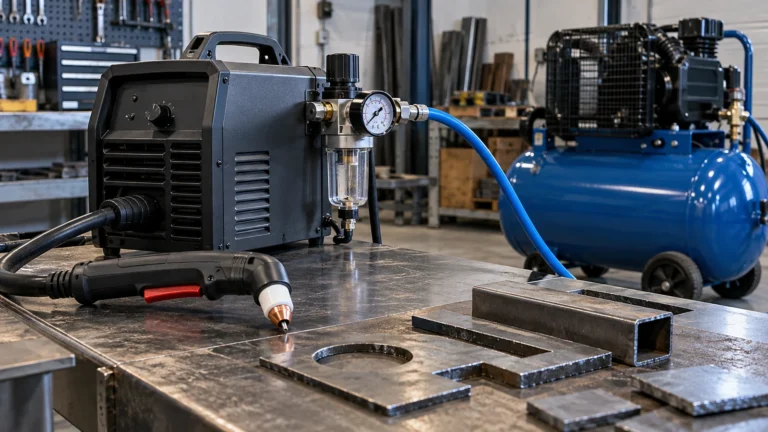
This is the step most likely to turn a convincing product description into a frustrating purchase. A compressor’s large tank and maximum PSI number do not tell you how much air it can deliver while the torch is firing. Compare delivered CFM at the required pressure with the cutter’s documented requirement, and account for other tools sharing the line. Current PrimeWeld CUT60 documentation calls for 5 CFM at 90 PSI; YESWELDER specifies at least 6.0 CFM for the NHF PLUS. For LOTOS LTP5505D, confirm the needed sustained airflow and pressure in the exact supplied manual before checkout rather than borrowing figures from a different LTP series.
Air quality deserves its own check. Hypertherm explains that moisture, oil mist, and particles affect edge quality, consumable life, and the torch. An onboard filter/regulator is not a guarantee of adequately dried air. Think of compressor output and clean-air treatment as part of the purchase, not free accessories that the cutting unit replaces.
4. Check torch parts before you plan ownership cost
Before buying, identify the installed torch, electrode and nozzle family, and exact retention components. LOTOS documents incompatibility even between older color variations of the same model name, and PrimeWeld has distinct CUT60 manual generations. Keep the model and serial information with the consumables list. Universal-looking torch tips are a poor place to guess, because a wrong fit can create a safety or performance issue.
5. Decide whether you need manual cutting or machine control
A non-HF pilot arc is helpful for some automation environments because it avoids high-frequency ignition interference, but that does not supply a CNC connector or authorize automated operation. PrimeWeld currently advertises CUT60 CNC readiness, subject to exact-generation confirmation. YESWELDER explicitly lists no CNC support for the NHF PLUS. If your purchase is mainly for an existing table, confirm controller compatibility, torch interface, height-control integration, manufacturer approval, and electrical noise behavior before selecting any of these units.
Safety requirements the machine cannot replace
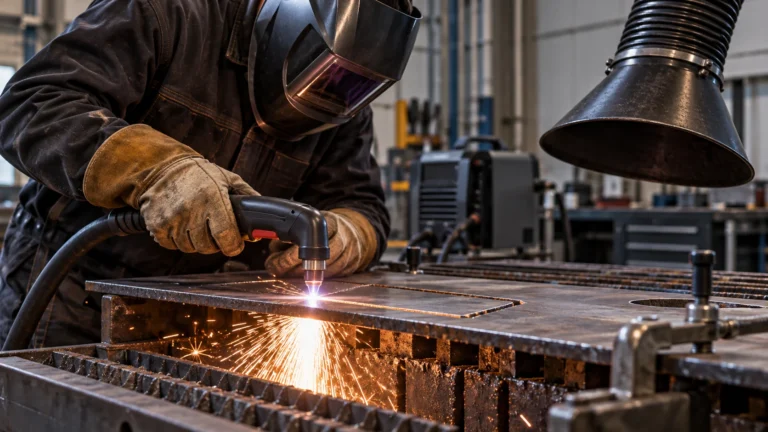
Plasma cutting produces an intensely bright arc, hot metal, sparks, electrical hazards, and potentially hazardous fumes. Follow the exact manufacturer’s operator and safety manuals. Wear arc-rated eye and face protection with the appropriate filter shade, flame-resistant clothing covering exposed skin, suitable gloves and footwear, and protect bystanders from arc exposure. OSHA’s general arc cutting and welding provisions describe eye protection and ventilation requirements for covered workplaces; local rules and hazard assessments can impose additional requirements.
Secure metal on a stable, noncombustible surface, remove or control combustible materials, and maintain suitable fire precautions. Cutting painted, galvanized, plated, or otherwise unknown metals can introduce coating-related inhalation hazards. Identify the material and evaluate local exhaust and other exposure controls before cutting. Never assume an ordinary fan or a dust mask universally makes an unknown coating safe.
Stop and consult a qualified technician or electrician if you encounter damaged cords, suspect grounding or power issues, repeated protective trips, unstable supply, a damaged torch, or pressure regulation you cannot verify. Do not open energized equipment, defeat interlocks, or run with damaged consumables.
When none of these three is the right purchase
You have no suitable compressor. Consider whether the total cost and space for a verified air system make sense; a cutter with an integrated compressor is a separate buying category and should be evaluated on its own limitations.
You mainly cut very heavy material all day. Choose a production-grade machine with documented recommended cutting speeds, duty-cycle requirements, service support, and correct electrical infrastructure. Treat the three picks here as general-shop options, not automatically industrial production systems.
You are buying specifically for a CNC table. Start with the table/controller manufacturer’s approved machine and torch requirements. No cutter becomes compatible just because the listing says non-HF.
You only make occasional straight cuts in thin stock. A properly guarded metal-cutting saw or other suitable process may be the simpler purchase. An air plasma system adds consumables, compressed air, and fume-control obligations that may not fit that job.
Frequently Asked Questions
What is the best plasma cutter for someone new to metal fabrication?
Start with a machine that matches your actual circuit, compressor, and usual thickness, rather than choosing the highest amperage. The LOTOS LTP5505D is an approachable option for occasional manual work, while the YESWELDER NHF PLUS adds useful cutting modes. Both still need correct PPE, ventilation, and a manual-verified power and air setup.
Can a 120V plasma cutter cut as well as it does on 240V?
Not at the same maximum output. The manufacturer specifications for the dual-voltage models in this guide show lower available cutting current on 110/120V. Use capacity claims tied to the actual input voltage and material, and confirm the installation requirements from your exact machine’s manual.
Does non-high-frequency pilot arc mean a plasma cutter works with CNC?
No. Non-HF describes one aspect of arc starting, not controller integration or manufacturer approval. The YESWELDER CUT-55DS NHF PLUS specifically lists CNC support as unavailable even though it uses non-HF starting. Confirm the table’s controller, torch connector, and machine revision before buying for CNC use.
Why do plasma cutter tips wear out unusually fast?
Air contamination and mismatched consumables are two important possibilities, alongside operating technique and other torch conditions. Hypertherm documents the effect of wet or oily air on consumable life, while LOTOS publishes model-specific torch-part restrictions. Stop using damaged components and follow the operator manual rather than fitting similar-looking parts by guesswork.
Which one should you buy?
For an established shop with adequate 240V input and dry compressed air, choose the PrimeWeld CUT60 after confirming its shipped generation and torch. For occasional hand-cutting and general repair work, choose the LOTOS LTP5505D if its current model and consumables meet your needs. Choose YESWELDER CUT-55DS NHF PLUS when its manual cutting modes matter and CNC does not. Buy none of them yet if the required circuit, airflow, fume controls, or material suitability is unresolved.
Research note: Product identities and specifications were cross-checked against current manufacturer pages and identifiable Amazon.com US ASINs on October 15, 2026. These are not laboratory performance tests. Availability, product revision, box contents, and seller offers can change; review the actual product page and manual before purchase.