
GearAndSteel is reader-supported. As an Amazon Associate I earn from qualifying purchases. When you buy through links on our site, we may earn an affiliate commission, at no extra cost to you. Learn more.
Plasma cutting uses a concentrated electric arc and fast-moving gas to melt and eject metal along a narrow path. It works on electrically conductive materials such as mild steel, stainless steel, and aluminum. For a small fabrication shop, the practical choice is usually a handheld air-plasma system, but the cutter is only one part of the setup: suitable electrical power, adequate clean compressed air, compatible torch parts, and protection from fumes, light, and hot metal matter just as much.
What plasma cutting does, and when it makes sense
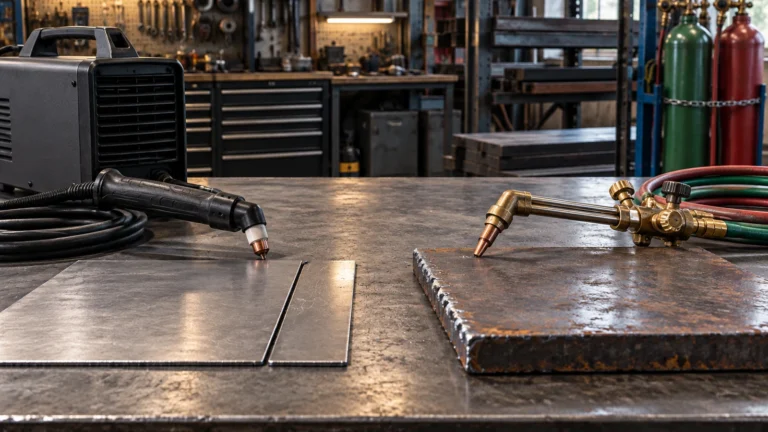
A plasma cutter removes metal rather than joining it. The torch constricts an electrically energized gas into a high-speed jet. The arc melts the workpiece locally while gas flow clears molten material from the cut, or kerf. Unlike oxyfuel cutting, the process does not rely on burning iron in oxygen, so it can cut conductive nonferrous metals as well as steel.
That makes plasma useful for cutting brackets, opening holes in sheet or plate, trimming fabrication parts, and preparing shapes before welding. It is not automatically the cleanest choice for every edge. If a part needs a close-tolerance machined surface, a fine finish, or a precise fit with no secondary cleanup, plan for further machining or choose another cutting process.
How a plasma cutter works
A typical air-plasma setup includes a power source, torch, consumables, work return lead, and an air supply. The machine starts an arc inside or near the torch, then transfers the cutting arc to the electrically conductive workpiece. The compressed gas both supports the plasma stream and helps clear molten metal. Different systems use different starting methods and torch designs, so the operator’s manual controls setup.
- Power and work circuit: The cutter delivers current to the torch and has a work return path through the properly connected clamp. The clamp is not a substitute for the equipment’s protective electrical grounding.
- Gas and torch: Air is common for handheld equipment; industrial systems may use other process gases. The torch’s electrode, nozzle, swirl ring, and shield or cartridge must match its exact system.
- Arc and cut: The plasma jet melts a narrow strip of metal. Travel speed, stand-off distance, current, and the condition of the consumables all affect the finished edge.
Plasma cutting is not a general-purpose heat gun: it depends on an electrical cutting circuit and is intended for conductive workpieces. It is not a way to cut timber, glass, plastic, or masonry.
Which metals can you plasma-cut?
Electrical conductivity determines whether a material can be plasma-cut, but it does not tell you how good the finished edge will be. Material thickness, alloy, surface condition, gas choice, and the machine’s cut chart still govern the result.
| Material | Practical takeaway | Before you cut |
|---|---|---|
| Mild or carbon steel | Common handheld plasma application for shapes and plate work. | Check actual quality-cut rating and intended thickness in the manufacturer’s cut chart. |
| Stainless steel | Conductive and cuttable, but edge oxidation and finish requirements may change the process choice. | Control fumes and check whether the cut edge needs further finishing. |
| Aluminum | Conductive and cuttable; edge finish depends heavily on setup and requirements. | Account for alloy, thickness, cut quality, and process-specific safety guidance. |
| Copper and brass | Can be cut with suitable equipment, though heat transfer and thickness can make results demanding. | Verify that the chosen system’s charts actually cover the material and thickness. |
| Painted, plated, galvanized, or unknown metal | Potential coating, fume, and contamination hazards. | Identify the material and coating first. Do not proceed without an appropriate exposure-control plan. |
One limitation beginners often miss: can sever the metal and can produce a useful, clean production cut are different claims. A maximum severance figure is not a sensible target for everyday edge quality. Compare a manufacturer’s recommended quality-cut range against your normal workload, not the thickest number on an advertisement.
Handheld air plasma vs. CNC plasma
Most first-time buyers need a handheld cutter. You trace a line or guide the torch along a fixture, and you can move it between jobs. A CNC plasma table automates travel for repeatable profiles, but it also introduces fixturing, torch-height control, programming, and a larger fume-management problem. The table is not a substitute for a suitable plasma power source and properly matched torch.
| Question | Handheld system | CNC table |
|---|---|---|
| Best job | Repairs, prototypes, one-off brackets, freeform trimming. | Repeated shapes and consistent batches. |
| Main constraint | Operator control and a steady torch path. | Table size, software, fixtures, extraction, and consumable costs. |
| Easy to overlook | Air compressor sizing and electrical supply. | Full installed system cost, including fume control. |
For occasional straight cuts alone, also evaluate whether a metal-cutting saw provides enough accuracy with less equipment. For a production shop, calculate how much repeated layout and manual cutting time automation would actually replace before moving to CNC.
How to choose plasma cutting equipment
1. Buy for your everyday metal thickness
Start with the material and thickness you cut most often. Find the machine’s documented cut chart and compare quality-cut capacity, recommended travel speed, and duty cycle under the stated test conditions. Do not treat a one-off severance cut as a repeatable production rating. If you routinely work near a machine’s upper limit, a system with genuine headroom is usually the more practical choice.
2. Check your electrical supply before selecting an amperage
Some portable units accept more than one input voltage, but available output and permissible branch-circuit requirements may differ substantially by voltage and model revision. Verify the exact manual, receptacle, protection, and circuit capacity with a qualified electrician where needed. Do not improvise adapters, defeat protective devices, or assume a household outlet will deliver the advertised maximum output.
3. Match compressor delivery, not just the pressure shown on its gauge
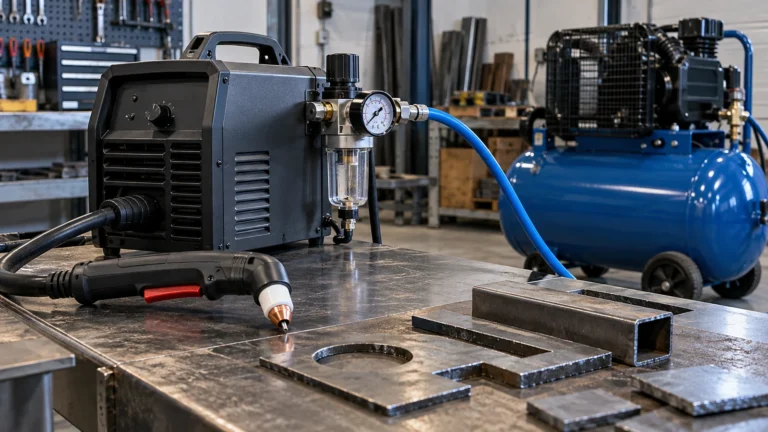
A full tank can make a small compressor seem adequate for a few seconds. The more useful question is whether it can deliver the manufacturer’s required continuous airflow at the specified operating pressure over the duration of the cut. Check the compressor’s rated CFM at that pressure and the plasma cutter’s demand. An undersized supply may produce unstable cuts even when the resting gauge initially reads high.
Air quality matters too. Water, oil, and particles can damage consumables and spoil edge quality. Use filtration and drying compatible with the machine’s instructions. Do not copy an air-pressure number from another brand’s setup; the correct setting belongs to the exact machine and torch.
4. Budget for torch parts, not just the box
Electrodes, nozzles, shields, and cartridges are wear items, but they are not interchangeable simply because two cutters look alike. Confirm the torch family, part numbers, amperage range, cutting method, and the availability of genuine replacements. A cheap machine with hard-to-source consumables can be a poor long-term purchase.
5. Decide whether portability is useful
A carry handle helps on a jobsite, but a portable cutter still needs approved power, suitable air, a safe work area, and fume control. If all the work happens at one fabrication table, reliable serviceability and air capacity may matter more than weight.
Three useful equipment checks before spending money
These are examples of equipment roles, not a ranked list or a claim that every buyer needs all three. Check the current listing, fit, and manufacturer instructions before ordering. A machine purchase is premature if you have not solved the power, air, and ventilation requirements.
PrimeWeld CUT60: an example of a standalone air-plasma cutter
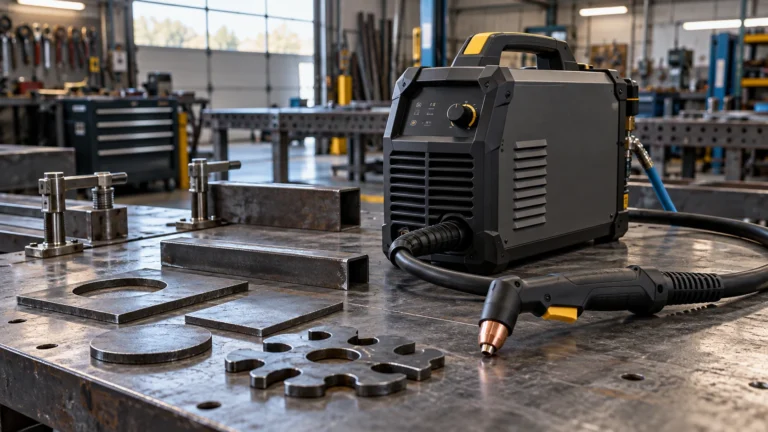
PrimeWeld lists the CUT60 as a dual-voltage air-plasma unit with a pilot-arc torch. It is relevant for someone comparing a dedicated handheld system with a shop’s actual power and compressor capabilities. Manufacturer documentation is organized by CUT60 generation, so check the generation and torch supplied with the current Amazon listing before relying on any output, input, or consumable specification.
Good fit to investigate: workshop users seeking a dedicated cutter rather than a combination welder. Skip for now: anyone without a confirmed circuit, sufficiently rated clean-air supply, or controlled cutting area.
Lincoln Electric K3110-ALL: additional torso protection
The K3110-ALL is a split-leather welding apron with an adjustable harness, according to Lincoln Electric’s apparel literature. It can be useful as added protection from sparks over suitable protective clothing. It does not replace a flame-resistant jacket, full skin coverage, or the correct face and eye protection.
Consider it when: torso exposure warrants another layer. Skip it if: you need a full-coverage protective garment and intend to rely on an apron alone.
Lincoln Electric premium leather MIG/Stick gloves: a hand-protection option
Lincoln Electric catalogs its K2980-series gloves for MIG/Stick welding, and the Amazon listing identifies a large-size premium leather variant. This is a candidate to evaluate for fit and cutting-task hazards, not evidence that every glove sold for welding provides sufficient dexterity, thermal protection, or cut resistance for every plasma operation. Follow the cutter’s PPE guidance and the glove maker’s intended-use limits.
Consider it when: you need appropriately fitting protective gloves for hot-work handling and plasma operations. Skip it if: its documented protection or size does not match your hazard assessment.
Often the smartest next purchase is not another cutter: an appropriately specified air dryer, safe workholding, or replacement consumable set may address a real bottleneck. Those parts must be matched to the exact system, so generic shopping links are intentionally omitted here.
A beginner’s first cut: the safe preparation sequence
Use this as a preflight checklist, not a substitute for the machine’s operating manual or supervised training. The manual sets the required consumables, torch position, power connection, air settings, and start procedure for your exact equipment.
- Identify the metal and its coatings. Stop if the coating or substrate is unknown and cannot be evaluated for harmful fumes or residues.
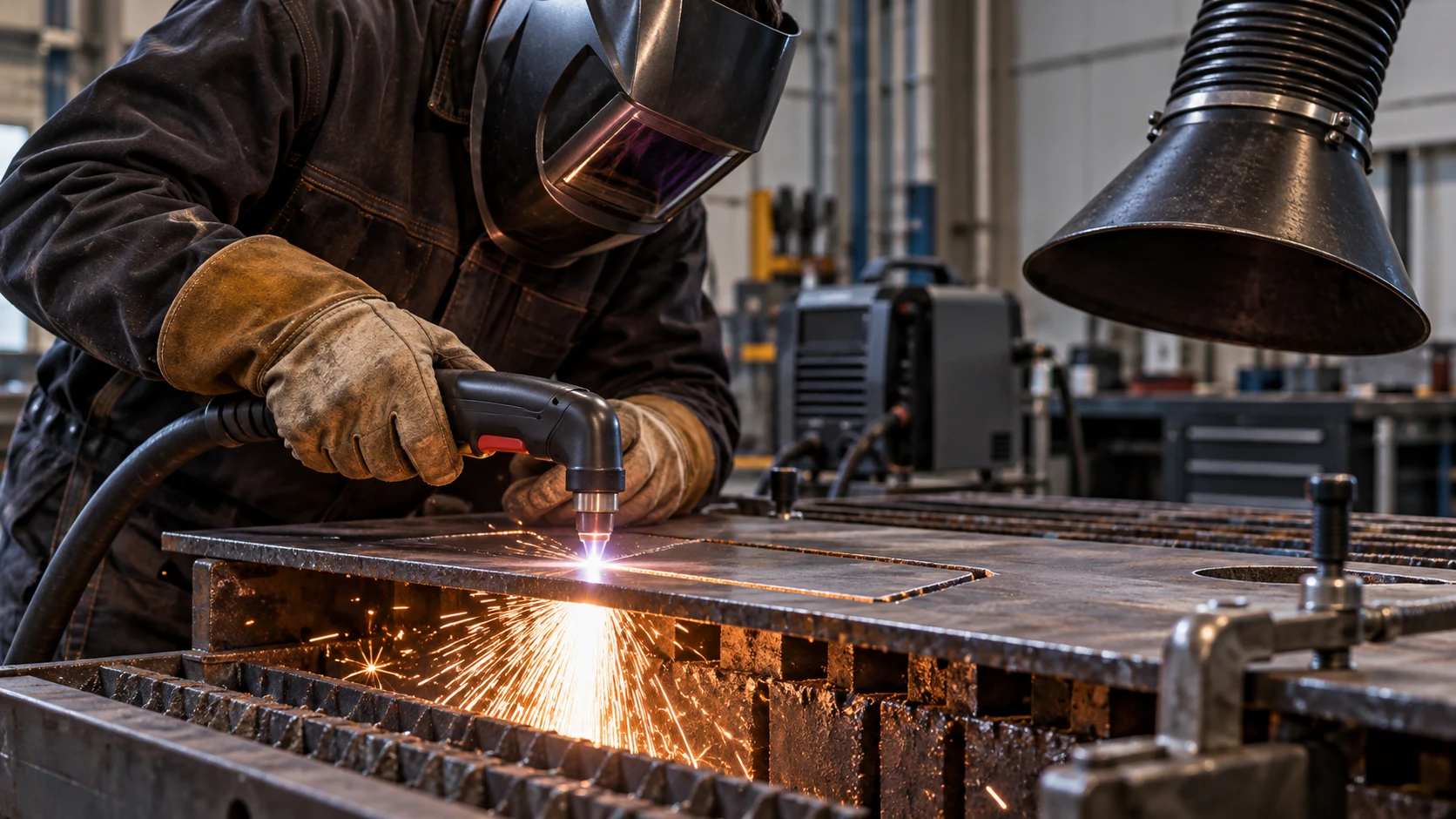
- Prepare a controlled area. Secure the workpiece over a suitable noncombustible cutting support. Remove or control combustibles, protect bystanders from radiation and flying metal, and provide appropriate local fume extraction and fire precautions.
- Inspect equipment while de-energized. Follow the manufacturer procedure for checking torch parts, insulation, cables, work connection, and dry-air supply. Do not service electrical internals or defeat interlocks.
- Put on task-appropriate protection. Use a suitable face-covering filtered helmet or face shield system, eye protection, protective clothing and gloves, hearing protection, and footwear. The required shade depends on the cutting operation and current; use the manual and applicable OSHA guidance rather than guessing.
- Confirm supply and machine setup. Use the approved electrical circuit, air source, and settings from the cut chart for the actual material and torch parts. If the supply cannot meet the requirement, do not start.
- Make a practice cut only after the setup is safe. Start with scrap of a known material within the documented range. Support the cutoff, keep your body clear of hot falling metal, and use the manual’s torch technique.
When cutting is complete, follow the shutdown and cool-down instructions. Metal and torch components can stay dangerously hot after the arc stops. Never handle recently cut pieces barehanded or assume the work area is free of ignition risk.
Why cuts turn out rough: diagnose the symptom before changing settings
A rough edge does not necessarily mean the cutter is too weak. Hypertherm’s cut-quality guidance separates causes such as travel speed, torch height, damaged consumables, and gas flow. First compare the actual setup against the machine’s cut chart; changing several variables at once can hide the cause.
| What you see | Possible causes to check | Safe next move |
|---|---|---|
| Heavy, rounded dross underneath | Travel too slow, stand-off or current not matched to the chart, worn parts. | Compare chart values and consumable condition after safe shutdown; test one approved change at a time. |
| Small hard bead underneath | Travel too fast, excessive stand-off, insufficient effective cutting energy. | Verify chart speed and torch position rather than simply increasing amperage. |
| Cut fails to penetrate | Thickness outside useful capacity, travel too fast, incorrect air supply, worn consumables. | Stop and review machine capacity and supply. Do not keep forcing a stalled arc. |
| Quality suddenly deteriorates | Moisture or oil in air, restricted gas path, consumable wear, electrical/work-connection issue. | Power down and inspect only user-serviceable items as the manual allows. Refer faults to qualified service. |
The central distinction is low-speed dross versus high-speed dross. They can both collect at the bottom edge while calling for different corrections. Never diagnose by the word “slag” alone, and never bypass the machine’s safety protection to chase a cleaner cut.
Plasma cutting safety: hazards the spark shower doesn’t show
Eye, face, and skin exposure
Plasma arcs produce intense visible and ultraviolet radiation. OSHA’s eye and face protection provisions distinguish plasma arc cutting from other welding and cutting operations, and the required filter shade depends on the process and current. A face-covering protective system matters because radiation can reach skin as well as eyes. Protect nearby people with appropriately arranged screening and keep unprotected observers out of the area.
Fumes and ventilation
Base metal, alloying elements, paints, plating, and residues can all affect the fume hazard. General room air movement is not proof of safe exposure. Use suitable source capture and the appropriate exposure assessment; respiratory protection, where required in a workplace, must be selected and managed under the applicable program. Stop cutting unknown, painted, plated, or galvanized material until hazards and controls are established. Never cut a closed container that may contain residues or flammable vapor.
Electricity, falling metal, and fire
The cutting circuit involves dangerous electrical energy. Work dry, maintain intact leads and equipment grounding, and follow manufacturer electrical requirements. Spark and molten-metal paths must not reach people, hoses, cables, or combustibles. Support the metal so heavy offcuts cannot fall unexpectedly. Follow applicable workplace hot-work procedures, including fire watch requirements where necessary.
Noise, compressed air, and hot surfaces
Hearing hazards and airborne metal particles may require additional controls. An air line can remain pressurized after cutting. Follow the manufacturer sequence before disconnecting any component, and let parts cool before handling or inspection.
Build the setup around the work, not the largest advertised number
A useful plasma station begins with the metals and tolerances you need, then works backward to the documented quality-cut range, branch circuit, sustained clean-air delivery, consumable availability, workholding, and fume control. If one of those is missing, buying the cutter first only moves the bottleneck.
For someone making occasional brackets or trimming steel sheet, a properly supported handheld air-plasma system can be practical. For repeated flat profiles, assess CNC productivity and its complete installed costs. For a couple of straight cuts a month, you might reasonably buy no plasma cutter at all.
Frequently Asked Questions
Does a plasma cutter need bottled gas?
Many handheld plasma cutters use clean, dry compressed air supplied by a suitable compressor, so bottled gas is not automatically required. Some industrial processes use other gases. Check the exact system’s gas specification; never substitute oxygen or another cylinder gas without the manufacturer’s approval.
Can you cut aluminum with an ordinary air-plasma cutter?
Aluminum is electrically conductive and can be cut by an air-plasma system that is rated for the material and thickness. Whether the edge is good enough depends on the application, surface finish, and approved cut chart. Do not assume a mild-steel thickness claim transfers unchanged to aluminum.
Is plasma cutting safe in a home garage?
Only when the site can support appropriate electrical supply, protected workholding, fire precautions, bystander screening, and a ventilation strategy matched to the metal and any coatings. A closed garage with only a household fan is not automatically a safe cutting area. If those controls cannot be provided, use a properly equipped shop instead.
Can you plasma-cut galvanized or painted steel?
Those coatings can create additional exposure and contamination hazards when heated. Identify the exact coating and follow a competent hazard assessment, removal or process-control requirements, and applicable respiratory and ventilation provisions before cutting. If the coating is unknown or controls are missing, stop rather than trying a quick test cut.